POM vs Nylon for CNC Machined Parts: How to Choose
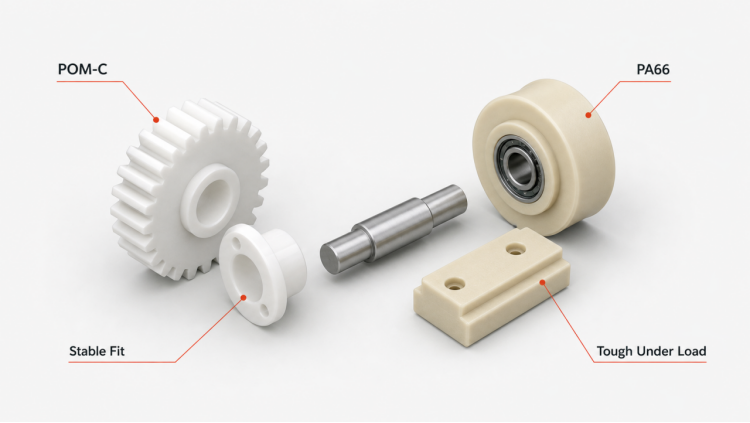
A material choice can pass quotation review and still fail at assembly. A nylon part may meet dimensions when dry and shift after moisture exposure, while a POM part may hold its fit but lack the toughness needed for repeated shock. The useful question is not which plastic is universally better; it is which one controls the dominant failure risk in your part.
POM vs Nylon: Choose by the Main Design Risk
| Design condition | Usually start with POM | Usually start with nylon |
| Precision fits and dimensional repeatability | Yes, especially where dimensions must remain stable through humidity changes | Possible, but grade, conditioning state, and inspection condition must be defined |
| Low-friction sliding | Common for gears, bushings, sliders, and guides | Useful for wear parts exposed to impact; performance depends on grade and lubrication |
| Impact, vibration, and repeated flexing | Verify carefully because some grades are more impact-sensitive | Often the better starting point because nylon generally offers greater toughness and fatigue resistance |
| Humid or changing environments | Usually easier to control dimensionally | Moisture-related dimensional and property changes require evaluation |
| Clean CNC edges and burr control | Chips and edges are often easier to control | Stringy chips, burrs, and spring-back may require tighter process control |
| Rigid precision components | Often the stronger candidate | Elastic recovery, creep, and conditioned dimensions need closer review |
As a starting rule, choose POM when dimensional stability, low friction, and clean machining dominate. Choose nylon when toughness, impact resistance, and vibration damping dominate. Final selection still depends on the exact grade, environment, load, geometry, and critical dimensions.
Define the Grades Before Comparing Properties
POM is not one material. Common categories include POM homopolymer (POM-H) and POM copolymer (POM-C); Delrin refers to a specific acetal homopolymer product family and should not be used as the name for every POM grade.
Nylon is also a family. PA6, PA66, cast nylon, unfilled grades, and reinforced grades can differ materially in stiffness, impact response, moisture uptake, heat performance, machining behavior, and wear.
Do not make a final selection by placing two generic property tables side by side. Compare specific grade datasheets under matching test methods, temperature, moisture condition, and specimen state.
What a Controlled Grade-Data Example Can Show
The following data comes from one unfilled machinable POM-C stock grade and one unfilled machinable PA66 stock grade reported by the same material supplier. The two columns use matched ASTM methods and can support early screening; they are not universal values for all POM and nylon grades and cannot replace the datasheet for the grade being purchased.
| Property | Unfilled POM-C reference grade | Unfilled PA66 reference grade | Test condition or method |
| Density | 1.41 g/cm³ | 1.14 g/cm³ | Supplier-reported value |
| Tensile modulus | 330,000 psi | 350,000 psi | ASTM D 638 at 73°F |
| Tensile strength at yield | 9,300 psi | 12,000 psi | ASTM D 638 at 73°F |
| Elongation at break | 40% | 50% | ASTM D 638 at 73°F |
| Flexural modulus | 400,000 psi | 440,000 psi | ASTM D 790 at 73°F |
| Dynamic coefficient of friction | 0.21 | 0.26 | ASTM D 3702 at 40 psi and 50 fpm |
| Water absorption after 24 hours | 0.18% | 0.45% | ASTM D 570 at 73°F |
| Moisture uptake at saturation | 0.80% | 8.5% | ASTM D 570 at 73°F |
| Heat-deflection temperature at 264 psi | 230°F | 194°F | ASTM D 648 |
The first lesson is that POM cannot be described as always stiffer or stronger than nylon. In this room-temperature example, the PA66 reference grade reports slightly higher tensile modulus, yield strength, and flexural modulus, so the exact grade matters more than a family-level slogan.
Moisture data creates the clearer selection risk. The reported saturation value for this PA66 reference grade is far above the POM-C value; that does not mean every nylon component will reach saturation, but it does mean that precision fits need a defined environment and material state.
The friction values are also screening data, not life predictions. Friction and wear can change with roughness, pressure, speed, temperature, moisture, mating material, and lubrication, so a life-sensitive application needs testing with the intended material pair.
The supplier pages do not fully state the conditioning history beside every value. Do not copy this table into a purchase specification; replace the reference grades with the actual ordered grades and verify the complete datasheets, specimen condition, and batch documentation before design release.
Moisture and Dimensional Stability Control Precision Fits
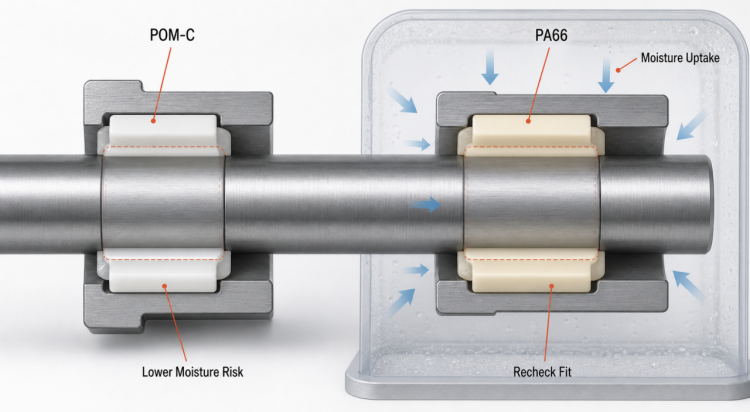
POM is generally less affected by moisture than common nylon grades, which makes it a frequent choice for gear center distances, bushing bores, sliding clearances, and locating features. It can still move because of temperature, stock stress, machining sequence, and asymmetric material removal, so low moisture uptake does not mean zero distortion.
Nylon moves toward moisture equilibrium with its environment, and both dimensions and mechanical response may change with conditioning. If a supplier machines and inspects a dry part that later enters a humid service environment, bores, wall sections, clearances, and assembly force may change.
For critical nylon fits, the drawing and RFQ should define:
- the nylon grade and reinforcement state;
- whether acceptance applies in a dry or conditioned state;
- the expected temperature and humidity range;
- which dimensions control function and which use general tolerances;
- whether critical dimensions require reinspection after stabilization.
These inputs prevent a common acceptance dispute: the part conforms before shipment but no longer assembles in its service environment.
Friction, Wear, Impact, and Creep Must Be Compared Together
POM is often selected for low-friction, dimensionally stable moving parts such as precision gears, bushings, sliders, and valve components. Its machined surfaces are usually clean, but impact, notches, and high strain still require grade-specific review.
Nylon generally offers greater toughness, impact absorption, and fatigue resistance, which can suit rollers, buffers, impact-loaded guides, and repeatedly loaded parts. Its friction and wear behavior depends on moisture, load, speed, mating surface, finish, and lubrication.
Creep also matters. Under sustained load, both materials respond to time, temperature, section thickness, and grade, so press fits, fastener preload, and long-term structural loads should not be sized from short-term tensile strength alone.
| Failure risk | What it means for POM | What it means for nylon | Design or validation action |
| Humidity-driven fit drift | Usually lower risk, with temperature and residual stress still relevant | Common risk; conditioning and acceptance state matter | Test critical fits in the intended environment |
| Repeated impact or vibration | Review notch sensitivity and grade toughness | Often the stronger candidate | Test prototypes under representative loads |
| Dry sliding | Often a stable starting point | Depends strongly on grade, moisture, and mating surface | Define pressure, speed, lubrication, and wear mode |
| Long-term static load | Check creep and temperature | Check creep plus moisture-dependent response | Do not select from room-temperature short-term strength alone |
| Interference or press fit | More stable dimensions, but stress concentration still matters | Greater elasticity, but moisture can change interference | Define assembly condition and service environment |
CNC Machining Behavior Changes Cost and Repeatability
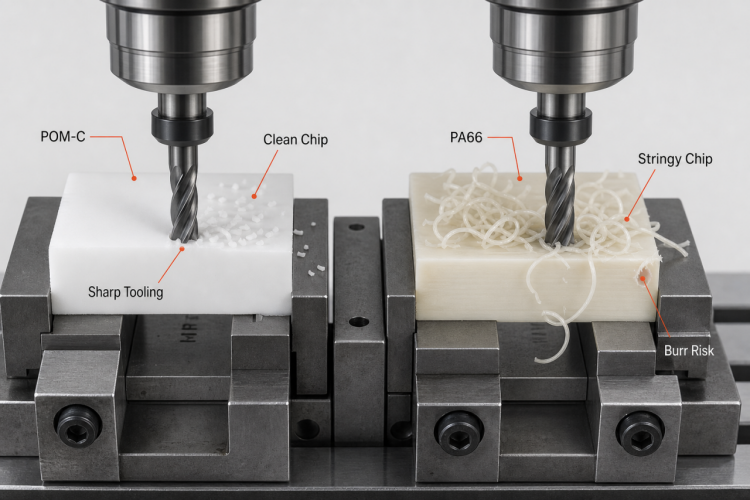
POM commonly produces clean chips and edges in milling and turning. Thin walls, deep pockets, or asymmetric stock removal can still release internal stress, so roughing, stabilization, and finishing sequence may control the final result.
Nylon’s toughness and elasticity create a different machining problem. Dull tools, unsuitable cutting conditions, poor chip evacuation, or excessive clamping can cause stringy chips, heat, burrs, spring-back, and size change after unclamping.
| Material behavior | Possible machining consequence | DFM and process-control focus |
| POM is relatively rigid and cuts cleanly | Crisp features are practical, but thin or asymmetric parts may still warp | Balance material removal, support the part, and retain finishing allowance |
| Nylon is tough and elastic | Stringy chips, burrs, spring-back, and clamp distortion | Use sharp tools, broad support, heat control, and restrained clamping force |
| Nylon conditioning changes | Dimensions may differ between machining and service states | Agree on material state, conditioning, and reinspection requirements |
| Reinforced grades contain abrasive fillers | Tool wear and surface response may change | Identify the filler in the RFQ and select suitable tooling |
| Either material has abrupt section changes | Local heat and residual stress can affect dimensions | Reduce severe section changes and identify only function-critical tolerances |
Raw stock price is only one cost driver. Cycle time, deburring, tool wear, stabilization, reinspection, scrap risk, and the number of critical tolerances all affect the final price of POM vs nylon CNC parts.
Select by Part Type and Dominant Failure Mode
| Part or condition | Better starting point | Reason and limitation |
| Small precision gear | POM | Low friction and dimensional stability often help; verify tooth-root toughness under shock |
| Impact-loaded or heavy-duty gear | Nylon | Toughness and impact absorption may help; manage moisture-related tooth and fit changes |
| Precision bushing or slider | POM | Usually easier to maintain clearance and stable sliding behavior |
| Impact-loaded roller or guide | Nylon | Often better at absorbing shock and vibration; check load, speed, and moisture |
| Interference fit in a humid environment | POM | Usually easier to control dimensionally; verify temperature and chemical exposure |
| Repeatedly flexed clip or compliant feature | Nylon | Toughness and fatigue behavior are often more suitable; validate the geometry with prototypes |
| Precision fixture or locating block | POM | Rigidity and dimensional stability usually support repeat positioning |
If a part needs both precision fit and high impact resistance, do not force a general-purpose grade to solve both requirements. Consider a modified grade, change the geometry or fit strategy, or machine small batches in both candidates for functional testing.
Validate the Choice with an Engineering Test Plan
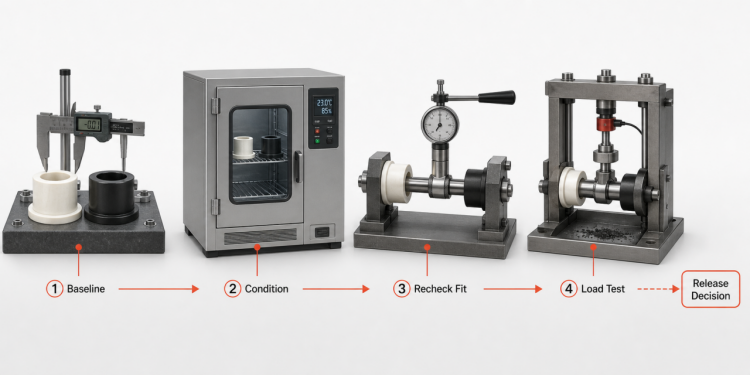
For gears, bushings, rollers, and precision fits, a datasheet cannot complete the validation. Standard specimens do not reproduce the wall changes, tool marks, bores, notches, clamping stress, or assembly preload in the machined component.
Use four test stages:
- Post-machining baseline: Record mass, critical bore or outside diameter, flatness, roundness, surface condition, and burrs. Record the material lot, grade, rod or plate orientation, and measurement temperature.
- Environmental conditioning: Apply the expected humidity, immersion, or dry-storage condition for an agreed period. For nylon, record mass before and after conditioning as a supporting indicator of moisture change.
- Functional recheck: Remeasure critical dimensions and assembly force, then check gear mesh, bushing clearance, roller torque, sliding resistance, or locating repeatability. Acceptance limits must come from product function, not a generic materials table.
- Load and wear check: Use representative load, speed, cycles, lubrication, and mating material. Record permanent set, cracking, surface wear, temperature rise, and functional drift.
| Data to record | Selection question | Possible design action |
| Mass change after conditioning | Is the nylon taking up meaningful moisture? | Change grade, conditioning requirement, or packaging plan |
| Critical dimensions before and after conditioning | Will the fit remain stable in service? | Change clearance, tolerance, or material |
| Dimensions after unclamping | Did machining stress or clamping hide movement? | Change workholding, rough/finish sequence, or stabilization time |
| Running torque or sliding resistance | Does the tribological pair meet function? | Change the material pair, surface, or lubrication |
| Permanent set after cycling | Is creep or fatigue affecting assembly? | Increase section, reduce preload, or select another grade |
| Burr and surface-defect count | Is the process repeatable for production? | Change tooling, cutting conditions, and deburring criteria |
Sample quantity and acceptance limits should follow failure consequence, production volume, and the quality plan. POM and nylon must be tested with the same geometry, measurement method, environment, and functional load; otherwise the results are not directly comparable.
Put the Operating Conditions on the Drawing and RFQ
For a POM vs nylon for CNC machining project, a CAD file alone rarely supports a safe material decision. The material must be reviewed with function, environment, and acceptance conditions.
Provide:
- the exact grade, or permission for the supplier to propose alternatives;
- load type, including static load, impact, vibration, or repeated flexing;
- temperature, humidity, water, oil, fuel, or other chemical exposure;
- critical fits, datums, threads, surfaces, and functional dimensions;
- dry or conditioned acceptance requirements for nylon;
- mating material, sliding speed, lubrication, and expected wear mode;
- prototype and production quantity, cosmetic requirements, and inspection documentation.
PlasticHubs can review the drawing, operating environment, critical fits, and candidate grade before confirming CNC manufacturability and quotation inputs. Review the POM CNC machining, nylon CNC machining, and plastic CNC machining capabilities before submitting the project.
For a DFM and quotation review, send the CAD file, candidate grade, service environment, critical dimensions, quantity, and inspection requirements through the PlasticHubs contact page.
POM vs Nylon FAQs
Is POM always stronger than nylon?
No. Strength may mean tensile strength, stiffness, impact toughness, fatigue, or long-term load capacity. POM is generally stiffer and more dimensionally stable, while nylon often has an advantage in toughness and impact response; the grade and environment decide the result.
Are Delrin and POM the same material?
Delrin belongs to a specific acetal homopolymer product family, while POM is the broader material category. Drawings and purchase documents should state the actual grade rather than use Delrin as a universal name for POM.
Should a gear use POM or nylon?
Start with POM for a precise, low-friction gear that must hold geometry. Start with nylon when impact, shock, or vibration is more important, then account for moisture-related tooth and fit changes.
Can nylon hold tight tolerances?
Yes, but the tolerance must be defined with the grade, size, geometry, machining state, conditioning state, and service environment. Dry inspection alone may not predict the assembled result after moisture exposure.
Is POM or nylon cheaper?
The generic polymer name is not enough to answer. Grade, stock availability, reinforcement, machining time, deburring, tool wear, inspection