Choose polycarbonate first when a machined part needs greater impact margin, controlled flex, or a less brittle failure response. Choose acrylic, also called PMMA, first when optical appearance, a hard exposed surface, polished edges, or long-term visual clarity drives acceptance.
Treat that choice as a starting point. The specified grade, stock form, geometry, temperature, chemical contact, cleaning process, assembly load, and coating can change the answer. A transparent part that looks correct at inspection can still fail later if machining stress, a fastener, or an incompatible cleaner was excluded from the material review.
Polycarbonate or Acrylic: The Short Answer for CNC Parts
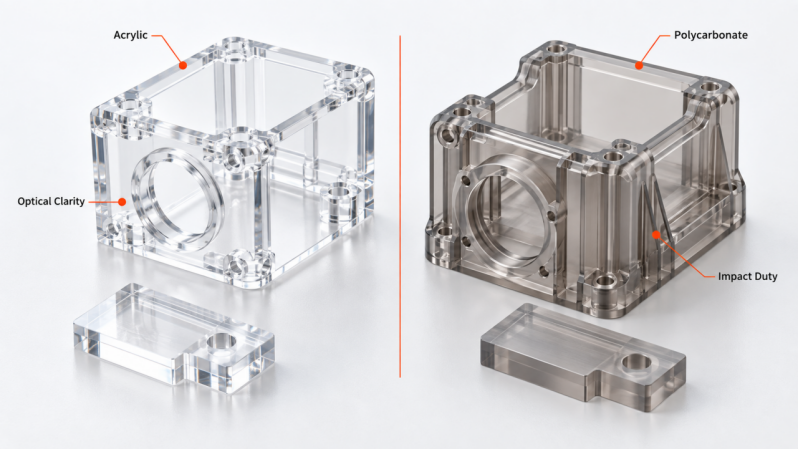
Polycarbonate is usually the preferred starting candidate for guards, covers, housings, and other parts where impact or flex is the leading concern. Acrylic is usually the preferred starting candidate for display windows, light-handling parts, polished transparent components, and other parts judged primarily by appearance.
Use three checks before locking the drawing:
- Choose by the dominant failure or acceptance condition. Impact consequence points toward polycarbonate. Optical and exposed-surface acceptance often points toward acrylic.
- Name the purchased material, not only the family. Cast, extruded, machine-grade, optical-grade, UV-stabilized, coated, and modified stock do not start with the same stress state or surface behavior.
- List what happens after machining. Polishing, fastening, bonding, cleaning, coating, and outdoor exposure can reveal risks that an as-machined inspection will miss.
If several conditions carry equal weight, keep both materials open through prototype or coupon testing. A generic “clear plastic” note gives the manufacturer too little information to validate the choice.
Compare the Requirements That Change the Choice
No single property selects every CNC part. Compare both materials under the same conditions, then verify the grade and finished geometry that will be used in production.
| Requirement | Polycarbonate starting point | Acrylic starting point | What to verify |
| Impact and failure consequence | Usually the first candidate when greater impact margin or controlled flex is needed | Better suited when impact is secondary to appearance and stiffness | Grade, thickness, temperature, notches, load direction, impact energy, and any required safety test |
| Optical and cosmetic appearance | Transparent grades are available; finish depends on grade, machining, and any coating | Often selected for high-gloss surfaces and polished transparent edges | Viewing zone, lighting, background, viewing distance, and an approved sample when appearance is critical |
| Exposed-surface damage | Uncoated stock may need added surface protection for demanding abrasion | A harder generic surface can favor acrylic for visible handling areas | Exact grade or hardcoat, abrasion method, cleaning method, and allowed marks |
| Machining and residual stress | Low-stress machine-grade plate is available for heavily fabricated parts | Machining, buffing, and flame polishing can add stress | Stock form, material condition, removed volume, part restraint, thermal history, and any grade-specific annealing plan |
| Cleaners and process fluids | Compatibility depends on the exact grade, stress state, chemical, concentration, temperature, and contact time | Stressed acrylic can craze, crack, or discolor after contact with incompatible products | Cutting fluid, cleaner, polish, adhesive, sealant, gasket, concentration, contact time, and a representative coupon test |
| Fasteners, threads, and notches | Toughness can provide useful margin, yet local stress and sharp features still need review | Rigid transparent parts need careful control of local stress and repeated assembly loads | Hole edge distance, radii, clearance, insert or washer strategy, torque, engagement, and service cycling |
| Outdoor and UV exposure | Select a specific UV-protected or coated grade for the required environment | Acrylic is often considered for strong visual weathering performance | Grade, color shift or haze limit, exposure side, service environment, warranty scope, and protected versus machined surfaces |
| Hard-coated surfaces | A named hard-coated grade can change the surface and UV comparison | Coating may be unnecessary when the selected acrylic already meets the surface requirement | Whether protection covers only supplied faces or also cut edges, holes, pockets, and reworked areas |
The final column prevents a common mistake: converting a material-family tendency into a finished-part guarantee. Part performance comes from the specific stock, geometry, process, assembly, and service environment together.
How Polycarbonate and Acrylic Behave During CNC Machining
Both materials can be CNC machined. Neither is universally easier. The useful comparison is how the selected stock reacts to heat, restraint, sharp geometry, material removal, and later finishing.
Start with grade and stock form
The same family name can cover sheet made for glazing, low-stress plate made for heavy fabrication, optical stock, coated sheet, and modified grades. A machine-grade polycarbonate plate can provide a better starting stress condition for a part with extensive pockets or tight dimensional requirements. That fact does not transfer automatically to generic polycarbonate sheet.
Resolve the acrylic stock form while the drawing is still being defined. Cast and extruded PMMA can respond differently to machining and finishing. Record the selected grade and stock form on the controlled drawing or material specification so a quote cannot silently substitute another starting condition.
For impact-led designs, the CNC polycarbonate machining route should be reviewed against the actual grade, geometry, assembly, and finish requirement.
Control heat, restraint, and stress raisers
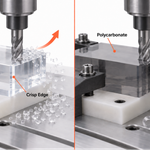
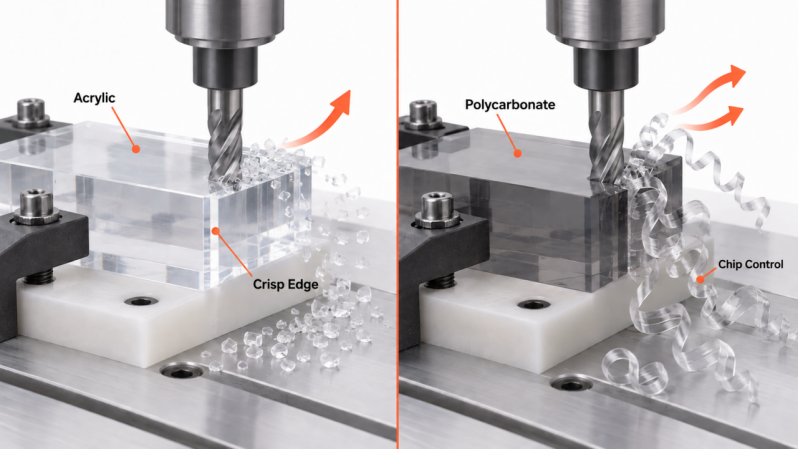
Cutting heat, poor chip removal, aggressive restraint, and sharp internal features can concentrate stress in a transparent plastic part. The machining plan needs sharp tools, stable support, effective chip evacuation, and a cutting strategy suited to the specified stock. Exact feeds, speeds, coolant, and annealing cycles belong to the material, tool, geometry, and machine setup; a universal recipe would be misleading.
Drilled holes, threads, counterbores, thin webs, deep pockets, and fastener seats deserve separate review. These features combine local geometry with installation load. A part can meet dimensions before assembly and show damage only after tightening, cycling, or chemical contact.
Inspection also needs a release condition. Dimensions taken while a warm or heavily restrained part remains in the fixture do not describe every later state. Define when the part is measured, which datums control fit, and which visual zones are inspected after finishing and handling.
Finishing, Clarity, and Residual-Stress Risk
A clear or polished surface does not prove that a part is free from residual stress. It also does not prove that a protective coating remains continuous across every machined feature.
Acrylic finish can change the stress state
Machining, wheel buffing, and flame polishing can introduce stress into acrylic. The risk matters when the part later contacts a solvent, cleaner, polish, adhesive, sealant, gasket, or cutting-fluid residue. An incompatible product can reveal the stress through crazing, cracking, or discoloration after the part has already passed a visual check.
Define the visible faces, transparent viewing zones, edge-finish requirement, and allowed handling marks separately. Then qualify the finishing route and any annealing step for the named grade and geometry. For appearance-led PMMA parts, CNC acrylic machining should be reviewed together with the finish and downstream chemical contact.
Coated polycarbonate changes the comparison
A hard-coated polycarbonate grade can improve surface hardness, abrasion behavior, or protection against a stated environment. The benefit belongs to that coating system and its qualified surfaces. Drilling, profiling, pocketing, countersinking, or edge finishing can remove the coating or expose an unprotected area.
Mark the coated faces on the drawing. State whether cut edges, holes, pockets, and reworked areas need equivalent protection. If they do, obtain a coating-specific fabrication route or validate a secondary treatment. Do not assign the supplied face rating to a machined edge without evidence.
Match the Material to the Part and Operating Environment
The dominant failure or acceptance condition selects the starting material. These scenarios show how the provisional answer can change once grade, geometry, finish, and service are included.
Impact-exposed guard or protective cover
Polycarbonate is usually the first candidate when repeated impact or a less brittle response matters. The decision still needs the actual load, support spacing, thickness, temperature, notch geometry, fasteners, and required test. A material-family choice alone does not establish a safety rating for the finished guard.
Polished display window or light-handling part
Acrylic is usually the first candidate when a high-gloss face, polished transparent edge, or visual weathering requirement controls acceptance. The reversal conditions are impact consequence, fastening stress, repeated cleaning, and any post-machining bonding or polishing that can raise residual stress.
Fastened transparent cover
Polycarbonate can offer useful toughness around assembly loads. Hole geometry, clearance, washers or inserts, torque, temperature cycling, and repeated service still control local stress. Acrylic can remain viable when appearance leads and the joint is designed and qualified for its load and maintenance cycle.
Outdoor enclosure or instrument window
Acrylic often starts ahead when long-term visual appearance is the main requirement. A specified UV-protected or hard-coated polycarbonate grade can change the comparison when impact also matters. Confirm which face receives the protection and how machined edges or holes will be treated.
Part exposed to cleaners, adhesives, or process fluids
Neither material family wins this scenario by name alone. Review the exact chemical formulation, concentration, temperature, exposure time, stress state, and surface finish. Test a representative machined and finished coupon when failure would affect function or appearance.
What to Specify Before Requesting a Quote
A useful material review needs the drawing, the purchased material condition, and the service environment. “Polycarbonate” or “acrylic” by itself is incomplete.
Include:
- 3D CAD and a revision-controlled drawing;
- preferred and acceptable alternate grade, stock form, thickness, color, and coating;
- prototype and production quantities;
- impact, static load, flex, temperature, and service-cycle conditions;
- holes, threads, inserts, fasteners, torque, and other locally loaded features;
- optical, cosmetic, edge, sealing, and non-visible zones with their acceptance method;
- machining, polishing, annealing, coating, printing, bonding, and packaging requirements;
- cleaner, cutting fluid, adhesive, sealant, gasket, or other contacting formulations;
- outdoor or UV exposure, including which surfaces and machined features need protection; and
- dimensional inspection timing, datums, critical features, approved samples, and any application-specific test.
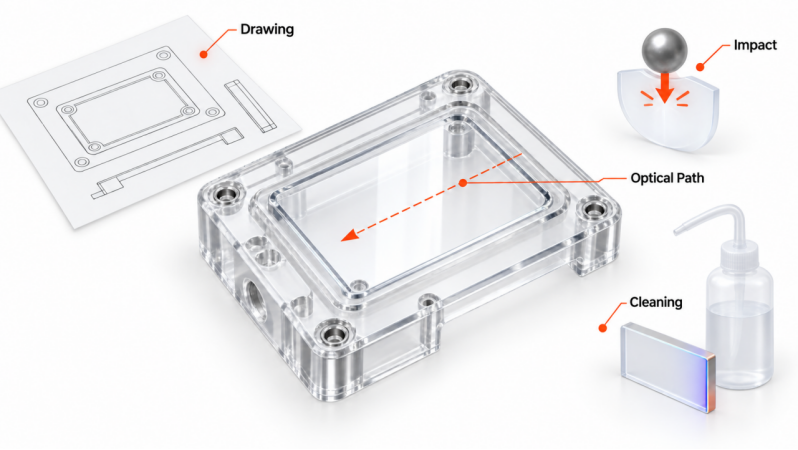
These inputs let a manufacturer review material, process, finish, and inspection as one decision. See PlasticHubs’ plastic CNC machining capabilities for the governing service route.
Discuss your acrylic or polycarbonate part with PlasticHubs. Include a drawing, quantity, and your impact, appearance, and cleaning requirements. Use the PlasticHubs contact form to send the project details.
Frequently Asked Questions About Polycarbonate vs Acrylic for CNC Machining
Is polycarbonate always the better choice for an impact-resistant machined part?
No. Polycarbonate remains the usual starting candidate, but a protective-part decision needs a defined impact event. State the impactor or contact shape, strike location, support condition, service temperature, whether the event is single or repeated, and what counts as acceptable after impact. Compare finished prototypes under those boundary conditions when the result controls safety or function; the material family alone cannot close the requirement.
Which material is less likely to crack during drilling or machining?
Separate the failure windows before changing material. A chip or crack that appears during drilling points first to the tool condition, heat, chip evacuation, restraint, and hole or edge geometry. Damage that appears after deburring, fastening, or cleaning points to residual stress combined with assembly load or chemical contact. Inspect after the last relevant operation as well as at machine release; the timing helps identify whether stock, geometry, machining, finishing, or assembly needs correction.
Can a hard-coated polycarbonate part be machined without losing surface protection?
Treat the supplied faces and newly created features as separate acceptance zones. If a cut edge, hole, pocket, countersink, or reworked face needs protection equivalent to the coated stock face, specify a coating-compatible secondary treatment and an inspection method for that feature. The stock-face specification does not by itself demonstrate coverage or performance on a surface created by machining.
Can the same cleaner be used on acrylic and polycarbonate parts?
Only after both finished material systems and the cleaning procedure have been qualified. Record the cleaner formulation or revision, dilution, application method, contact time, wipe or rinse step, drying method, frequency, and temperature. A one-time compatibility check does not establish repeated-cleaning service. When the consequence warrants it, test a coupon that reproduces the selected stock, machining, finish, stress state, and cleaning cycle.