Plastic surface finish can come from the tool that creates the part, the manufacturing process itself, or a later operation such as polishing, blasting, painting, coating, or printing. Those routes are not interchangeable.
For injection-molded parts, SPI, VDI, and Mold-Tech usually describe the mold surface that is transferred to each part. For CNC-machined or 3D-printed parts, the starting surface comes from cutting or building, and any later finish is applied to the individual part.
That distinction should appear before a buyer selects “glossy,” “matte,” or “textured.” A finish is useful only when the drawing also states where it applies, what sample or standard controls it, and how the result will be inspected.
First separate mold finish from secondary finishing
An injection-molded surface repeats the condition of the mold cavity, influenced by the resin, color, filler, flow, and processing conditions. A polished cavity can create a glossy molded surface; a blasted, EDM, or chemically textured cavity can create a matte or patterned surface.
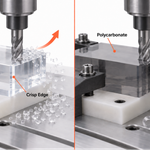
A machined plastic surface starts with tool paths. A printed surface starts with layers, powder, support contact, or another process signature. These can be left as produced or changed by secondary finishing.
The first specification question is therefore not “Which finish name do we like?” It is:
- Is the finish built into a mold?
- Is it the natural output of machining or printing?
- Is it applied later to each part?
The answer affects cost, geometry, draft, dimensional risk, maintenance, color consistency, and the way a sample should be approved.
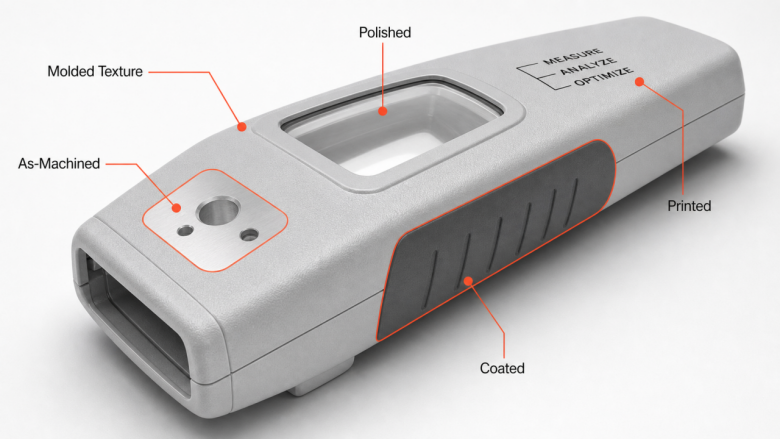
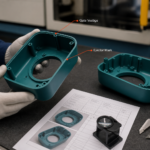
Figure 1. One product can use different finish sources on separate cosmetic and functional zones.
SPI grades organize molded polish and texture
The finish system still commonly called SPI groups injection-mold surface preparation into four families, A through D. Each family contains three grades. The designation describes how the mold surface is prepared and the general appearance expected on the molded part.
| SPI family | General mold preparation | Typical visual direction |
| A | Diamond polishing | High gloss to mirror-like appearance |
| B | Fine abrasive paper | Semi-gloss to lower gloss |
| C | Fine stone preparation | Matte, low-gloss appearance |
| D | Dry blasting with selected media | Satin to visibly textured appearance |
The letter alone is not a complete callout because A‑1, A‑2, and A‑3 are different levels, as are the three grades in the other families. Specify the full designation and confirm it with a physical plaque or approved part when appearance is commercially important.
A smoother category is not automatically “higher quality.” A controlled matte housing may be more appropriate than a mirror surface because it reduces glare, hides minor handling marks, or supports the intended visual language. The best grade is the one that meets the product requirement without adding unnecessary tool work.
Where VDI and Mold-Tech fit
VDI 3400 is commonly used for mold textures associated with electrical discharge machining or comparable reference surfaces. Its numerical designations provide another shared language for textured molded parts.
Mold-Tech is a proprietary texture system based on catalogued patterns and reference plaques. It is useful when a product needs a repeatable grain or decorative pattern rather than only a general roughness family.
SPI, VDI, and Mold-Tech should not be converted casually from one to another. A table can suggest a visual neighborhood, but different creation methods and texture shapes may still look different on the finished resin.
For critical appearance, use the exact designation, the resin and color intended for production, and a physical sample. A texture viewed on a flat black plaque may not look the same on a curved translucent part.
Secondary finishes applied after molding, machining, or printing
Secondary finishes are applied to each part after molding, machining, or printing. They can change color, gloss, touch, chemical resistance, conductivity, visibility, or branding.
Common routes include:
Polishing
Mechanical polishing removes or smooths surface irregularities. It can improve accessible machined plastic faces and edges, but it may also round corners or change dimensions if allowances and protected zones are not defined.
Blasting
Blasting can create a more uniform matte appearance or prepare a surface for another finish. The media, pressure, exposure, material, and geometry influence the result. Thin or delicate parts need special review.
Painting and coating
Paints and coatings can provide color, opacity, gloss control, chemical protection, or another functional layer. Adhesion depends on the plastic, surface preparation, cleaning, primer, and cure conditions.
Printing and marking
Screen printing, pad printing, laser marking, and related processes add graphics, symbols, serial information, or branding. The drawing should identify artwork, registration, color, durability, and the no-print zones needed for assembly.
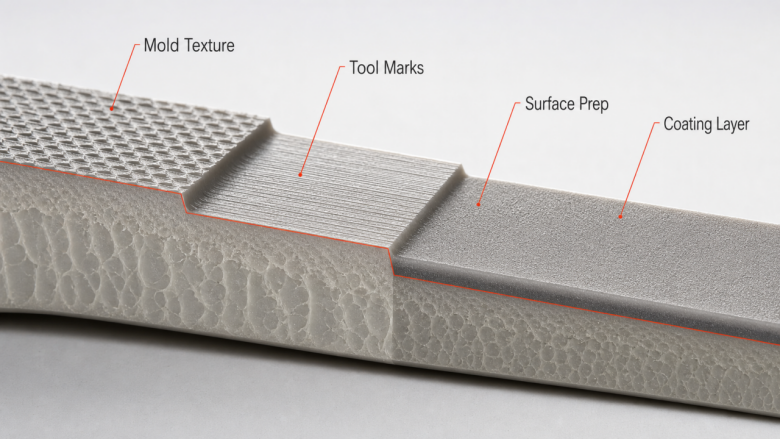
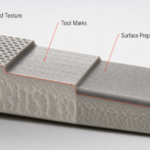
Figure 2. Mold texture, machining marks, surface preparation, and coatings are separate finish sources—not successive grades of one system.
Write and inspect the finish as a controlled requirement
Material and geometry change the visible result
The same mold texture or coating can look different on different plastics. Resin color, translucency, fillers, flow pattern, shrinkage, and process conditions influence how faithfully a surface is reproduced.
Geometry matters too. A deep texture on a near-vertical molded wall can affect release from the tool and may require more draft. A high-gloss surface can expose sink, weld lines, flow variation, or waviness that a controlled texture would make less visible. A coating can bridge small detail or interfere with a fit if thickness and masking are ignored.
Do not approve the finish independently of the production material and geometry. The safer sequence is to review the finish with the resin, color, draft, feature depth, and functional interfaces visible in the same conversation.
Turn an appearance word into an inspection method
Words such as “premium,” “smooth,” “satin,” or “no scratches” are too subjective to control a batch. A practical finish specification answers five questions:
- Which surface? Mark cosmetic, hidden, sealing, bonding, datum, grip, and print zones.
- Which reference? State the full SPI, VDI, or Mold-Tech designation, or identify the approved sample.
- Which material and color? Record the resin grade, filler, color, and translucency that will be judged.
- How will it be viewed? Agree on lighting, distance, angle, background, and whether magnification is used.
- What may vary? Define allowable gloss, color, texture, witness, gate, or handling variation where it matters.
A drawing can control location, but appearance often needs a physical limit sample. Keep the approved sample identified by revision and protect it from wear or contamination.
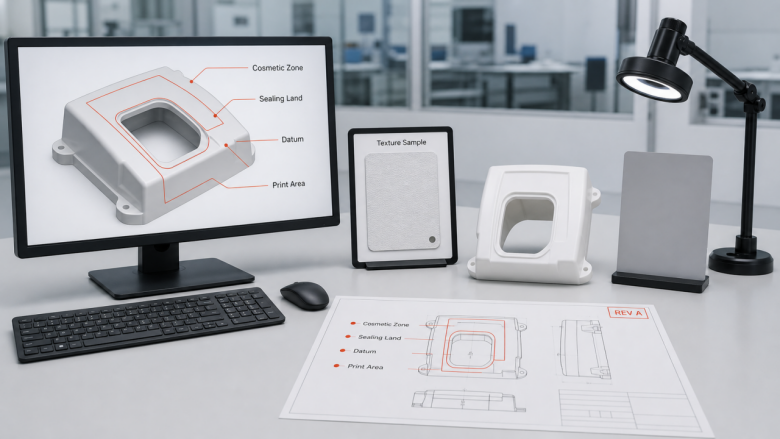
Figure 3. A finish becomes auditable when the drawing zones, reference sample, production part, and viewing conditions agree.
Review plastic finish samples with PlasticHubs before approval
Before approving a plastic finish, compare representative samples made with the intended material, color, geometry, and finish under the lighting in which the product will be judged. A physical comparison usually controls appearance more clearly than a longer list of adjectives.
For machined parts, the PlasticHubs CNC machining service can separate as-machined datums from polished, blasted, printed, or coated zones. For molded or cast projects, the same zone logic helps prevent a cosmetic instruction from changing sealing, bonding, or assembly surfaces.
Send the CAD model, drawing, material, color, process, finish reference, cosmetic zones, functional exclusions, and sample-approval method through the PlasticHubs engineering contact. The useful outcome is a finish plan that can be manufactured and inspected—not another subjective label.
Frequently asked questions about plastic surface finishes
What is the difference between SPI and VDI?
SPI groups common mold-polishing and texturing methods into A–D families with three grades in each family. VDI 3400 uses numerical designations for reference textures commonly associated with EDM. They are different systems and should be specified by exact designation rather than loosely converted.
Is Mold-Tech a surface roughness value?
Mold-Tech is primarily a proprietary pattern and texture reference system. A Mold-Tech code identifies a catalogued texture; approval should use the relevant plaque or sample rather than a generic “matte” description.
Can the same plastic part have more than one finish?
Yes. A housing may have a textured cosmetic body, a polished window, an as-machined datum, a sealing land, and a printed marking area. Mark each zone so the finish operation does not interfere with function.
Does a matte finish hide every molding defect?
No. Texture can reduce glare or make some minor visual variation less noticeable, but it does not correct sink, poor filling, weld lines, contamination, or dimensional problems. Material, geometry, mold design, and process conditions still control the underlying part.