Plastic CNC Machining vs Plastic Injection Molding: When to Use Each Process
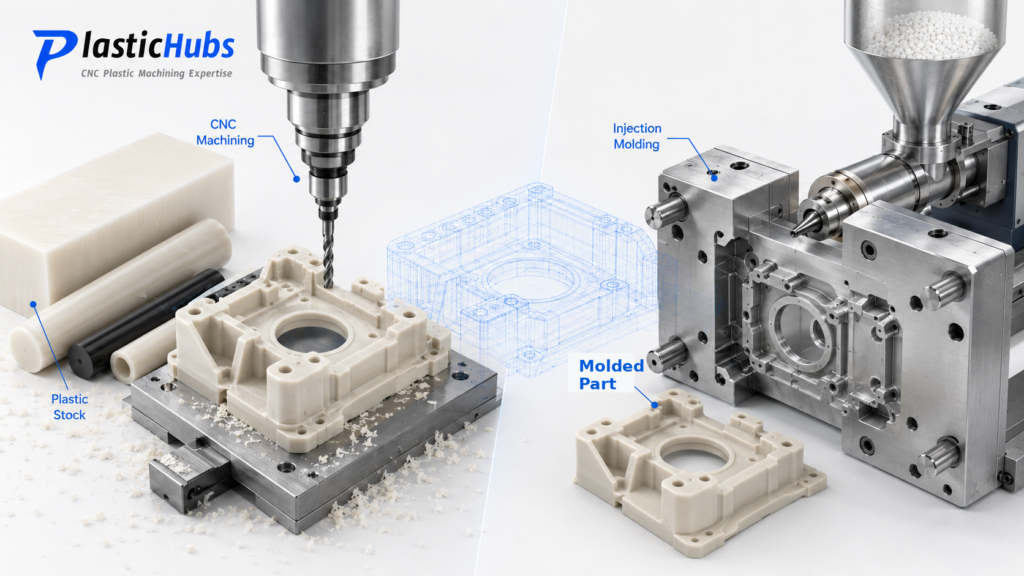
If a plastic part’s dimensions, fit, or cosmetic requirements may still change, building a mold too early makes later revisions expensive. Even a later change to a hole location, wall thickness, or snap-fit can require mold rework, new samples, extra tooling cost, and delivery risk.
That is the core issue behind the plastic CNC machining vs plastic injection molding decision. The real question is not which process is more advanced. The real question is whether the project is ready for mold cost, tooling lead time, and mold-rework risk.
Plastic CNC machining is usually the better route for functional prototypes, low-volume plastic parts, bridge production, replacement components, and custom parts that need real engineering-plastic performance.
Plastic injection molding is usually better when the drawing is approved, demand is repeatable, and the mold investment can be spread across enough parts.
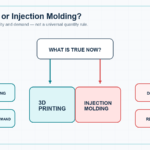
If the part still needs validation for assembly, hole locations, sealing faces, sliding surfaces, material stiffness, or cosmetic dimensions, CNC machining is usually safer first. If the part is already mold-ready and will be produced repeatedly in large quantities, injection molding usually has the stronger long-term cost advantage.
How Plastic CNC Machining and Injection Molding Make Parts Differently
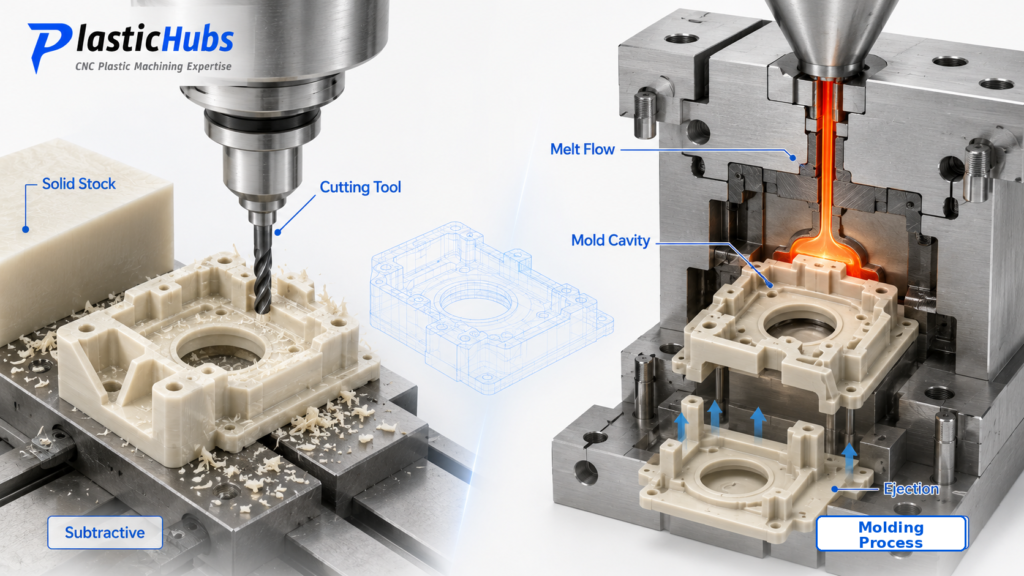
Plastic CNC machining is subtractive manufacturing. A cutting tool removes material from solid plastic stock such as sheet, plate, rod, tube, or block until the final geometry is produced.
Plastic injection molding is mold-based manufacturing. Thermoplastic resin is melted and injected into a mold cavity, then packed, cooled, and ejected as a molded plastic part.
This process difference directly affects cost, lead time, material choice, geometry limits, and tolerance logic. CNC machining can skip production tooling and machine parts directly from available plastic stock.
Injection molding must first go through mold design, mold fabrication, sampling, and process adjustment before molded parts can be produced consistently. For that reason, injection molding works best when the part has already passed design validation and is ready for repeat production.
A CNC-machined part should not be treated as automatically mold-ready. A machined prototype can prove fit and function, but the molded version still needs review for draft, wall thickness, flow, shrinkage, cooling, gate location, parting line, and ejection method.
Choose by Stage, Volume, and Tooling Risk
In an early-stage project, the lowest unit price is usually not the first goal. The more important questions are whether the part fits, whether it passes functional testing, whether the material suits the service environment, and whether the design may still change.
If those questions are not validated yet, plastic CNC machining should usually be evaluated first. It can produce real plastic parts without a mold, allowing the engineering team to check dimensions, assembly fit, hole locations, sealing faces, sliding surfaces, threads, material stiffness, and thermal or chemical performance.
When the drawing is approved and the key dimensions, material, and cosmetic requirements are no longer changing frequently, plastic injection molding becomes worth evaluating. The advantage of molding is not early flexibility. Its advantage is lower per-part cost after the mold has been built and qualified.
Quantity alone should not decide the process. For a 100-piece project, CNC may still be better if the design is under test. For a 500-piece project, injection molding may be better if repeat orders are expected and the part is already mold-ready.
A more accurate decision is based on total project risk. CNC is safer when design-change risk, mold cost, mold-rework cost, and schedule risk matter more than unit-price pressure.
Injection molding has the stronger long-term cost advantage when demand is stable, the drawing is clear, and volume is high enough to amortize the mold.
Process Selection Guide
| Project Requirement | Evaluate Plastic CNC Machining First | Evaluate Plastic Injection Molding First |
| Project stage | The part is still being tested, adjusted, or validated. | The design has passed validation and is ready for repeat production. |
| Quantity | Prototype, one-off, low-volume batch, bridge run, or replacement part. | High-volume or repeat production with stable demand. |
| Upfront cost | The project needs to avoid mold fabrication before the design is proven. | The project can justify mold design, fabrication, sampling, and qualification. |
| Design changes | CAD revisions are expected after fit, assembly, or functional testing. | Key dimensions, material, and cosmetic requirements are stable. |
| Material requirement | The test depends on a machinable engineering-plastic stock grade. | The final resin has been selected for molding. |
| Geometry | Features can be reached by cutting tools and held securely during machining. | The part is designed for draft, wall thickness, gates, ejectors, shrinkage, and cooling. |
| Main risk | The design may change before production. | The mold must produce repeatable parts at scale. |
| Best role | Functional validation, low-volume production, and tooling-risk reduction. | Scalable production after design freeze and mold qualification. |
This table is a first filter, not a final answer. The correct process still depends on material grade, part size, tolerance targets, surface requirements, inspection scope, lead time, and total project cost.
When Plastic CNC Machining Is the Better Choice
Choose plastic CNC machining when the part still needs testing, design changes are likely, or production volume does not justify a mold. It is especially useful when the part must be made from real engineering plastic stock rather than a substitute prototype material.
Common use cases include functional prototypes, CNC plastic prototypes, low-volume machined plastic parts, bridge production, replacement components, jigs, fixtures, and custom plastic parts.
CNC machining is also a strong route when the project needs controlled holes, flat datums, machined threads, sealing faces, bearing surfaces, or sliding interfaces. These features often control whether the part fits, seals, moves, fastens, or passes inspection.
For example, a team may need a POM, PEEK, PTFE, acrylic, polycarbonate, nylon, ABS, or PVC part to test fit, friction, insulation, stiffness, chemical exposure, or temperature exposure. Machining the part from stock can provide a more useful functional sample than opening a mold before the design is proven.
The main advantage is flexibility. If the part changes after testing, the CAD file and machining program can be revised without changing a mold.
The limitation is unit cost at scale. CNC machining removes material one part at a time, so it is usually not the most economical long-term method for mature high-volume plastic parts.
When Plastic Injection Molding Is the Better Choice
Choose plastic injection molding when the part is ready for repeat production. The drawing, material, cosmetic requirements, and key functional dimensions should already be stable.
Injection molding is often the better route for thin-wall plastic housings, molded ribs, bosses, snap-fits, textured cosmetic surfaces, clips, covers, brackets, and consumer or industrial parts that will be made repeatedly.
Its strength is not early flexibility. Its strength is scalable production after the mold is built, sampled, corrected, and qualified.
Once the mold is ready, injection molding can produce parts with consistent geometry and a lower per-part cost across larger volumes. Multi-cavity molds can also produce multiple parts per cycle, which improves production efficiency when demand is high enough.
The risk is starting too early. If the hole positions, wall thickness, assembly interfaces, material selection, or appearance requirements still need changes, a mold can become expensive to modify.
For that reason, injection molding should usually follow design validation. It is strongest after design freeze, when the drawing, material, and cosmetic requirements are no longer changing.
Cost Logic: Mold Investment vs Accepted-Part Cost
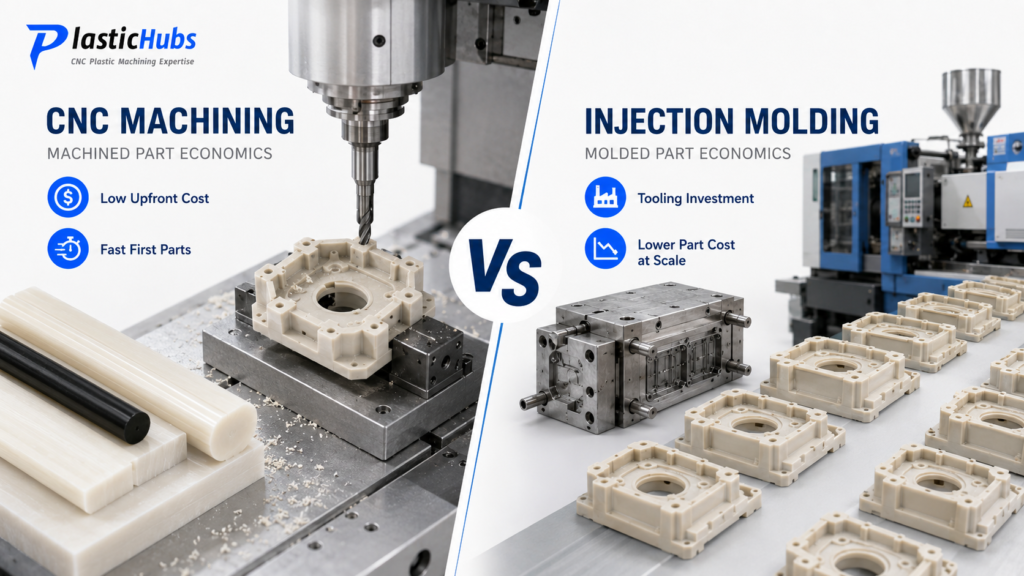
The cost difference is not simply “CNC is cheap” or “molding is cheap.” The real difference is where the cost appears in the project.
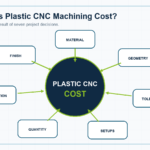
Plastic CNC machining usually has lower upfront cost because it does not require a production mold. The quote is driven by material, programming, setup, machining time, fixturing, inspection, finishing, tolerance requirements, and quantity.
Plastic injection molding usually has higher upfront cost because the mold must be designed, manufactured, sampled, and corrected before stable production. After the mold is qualified, the per-part cost can drop sharply because each cycle can produce one or more parts.
There is no universal break-even quantity. A simple small part with a low-cost tool may move to molding earlier, while a complex engineering plastic component with uncertain demand may stay with CNC machining longer.
Buyers should compare the cost of accepted parts, not only the first quoted unit price. A low molding unit price can become expensive if the tool needs rework after the first sample.
The practical rule is simple: CNC machining protects the project when change risk is high. Injection molding protects unit cost when the design and demand are stable.
Lead Time: First Parts, Bridge Runs, and Repeat Production
For first parts, plastic CNC machining usually has the lead-time advantage. It can start from available plastic stock and does not wait for mold fabrication.
This makes CNC useful for early prototypes, engineering samples, urgent replacement parts, and bridge production before tooling is ready. If the design changes, the supplier can update the machining program and produce a revised part.
Plastic injection molding usually takes longer before the first molded parts are available because the mold must be designed, built, tested, and adjusted. Even rapid tooling still requires a tooling step.
After the mold is qualified, injection molding has the production-speed advantage. Each molding cycle can produce one or more parts, and a multi-cavity mold can increase output further.
The right lead-time question is not “Which process is faster?” It is “Do you need the first validated parts quickly, or do you need stable repeat production after tooling?”
Material Choice: Machinable Plastic Stock vs Moldable Resin
Material choice is one of the most important differences between plastic CNC machining and plastic injection molding.
Plastic CNC machining uses solid stock materials such as sheet, plate, rod, tube, or block. Common CNC-machined plastics include ABS, POM/Delrin, nylon, PEEK, PTFE, acrylic/PMMA, polycarbonate, PVC, HDPE, UHMW-PE, PEI, PPS, and other engineering plastics available in machinable form.
Plastic injection molding uses thermoplastic resin pellets. The material must melt, flow, pack, cool, and eject correctly inside the mold.
The same material-family name does not guarantee the same behavior. A machined nylon plate and an injection-molded nylon resin may differ in filler content, moisture behavior, shrinkage, crystallinity, mechanical properties, and processing history.
This matters for testing. A CNC-machined part can help validate geometry, interfaces, and some material behavior, but it does not reproduce molding effects such as flow direction, gate location, weld lines, shrinkage, cooling rate, or molded-in stress.
Soft elastomers and very flexible plastics are also special cases. They can be difficult to machine cleanly because they deform under cutting forces, while molding may form them more consistently.
Before treating a prototype as material evidence, compare the exact grade, filler, moisture condition, heat treatment, and data-sheet test conditions.
Geometry and DFM: Tool Access vs Moldability
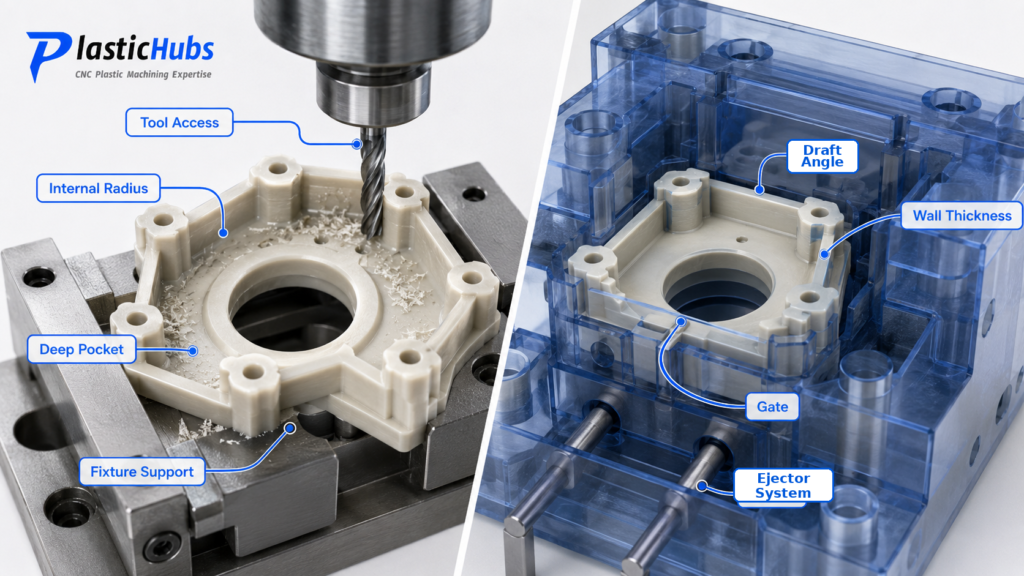
CNC machining and injection molding fail for different geometric reasons. A design that is easy to machine may not be easy to mold, and a molded design may be inefficient to machine.
For plastic CNC machining, the main DFM issues are tool access, cutter diameter, internal corner radius, deep pockets, thin walls, long narrow slots, part stiffness, clamping, vibration, heat buildup, burrs, and inspection access.
A CNC cutting tool cannot create a perfectly sharp internal corner. Deep pockets and small internal radii can require longer tools, smaller cutters, extra setups, or design changes.
Thin plastic walls also need review. Plastics can flex, heat up, absorb moisture, or move after material is removed, especially in long unsupported features.
For plastic injection molding, the main DFM issues are draft angle, wall thickness, ribs, bosses, gates, ejector pins, shrinkage, sink marks, warpage, parting lines, undercuts, flow length, and cooling balance.
A molded plastic part must fill, pack, cool, and eject repeatedly. That means wall thickness and flow path often matter more than the original CAD shape.
This is why a CNC prototype should not be sent directly to tooling without moldability review. The machined version may prove function, but the molded version still needs DFM for production.
Tolerance and Surface Finish: What Each Process Can Actually Control
Tolerance should not be reduced to a simple claim that CNC is always more accurate or injection molding is always less accurate. Both processes can produce accurate parts when the design, material, and process are controlled.
Plastic CNC machining can hold tight local features when the material is stable, the geometry is accessible, the wall is supported, and the part can be fixtured and inspected correctly.
For general plastic CNC machining, supplier standards often reference ISO 2768-c unless tighter tolerances are clearly specified on a drawing. Tighter features can be reviewed when the drawing, GD&T, material, geometry, and inspection method are clear.
Injection molding has a different tolerance problem. The mold can be manufactured very precisely, but the final molded part is affected by resin shrinkage, mold temperature, cooling balance, packing pressure, wall thickness, gate location, part size, and post-mold conditioning.
Do not treat mold tolerance as the same thing as molded-part tolerance. The molded part is controlled by both tool accuracy and plastic process behavior.
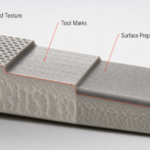
Surface finish also comes from different sources. For CNC-machined plastic parts, finish depends on material, cutter condition, toolpath, feed rate, chip control, fixturing, and post-processing.
For molded plastic parts, finish depends on mold texture, resin flow, venting, gate location, cooling, and ejection. Texture, logos, parting lines, and ejector pin positions should be planned before tooling.
The best surface requirement is not “smooth.” State whether the surface must seal, slide, remain transparent, match a cosmetic sample, or receive another finish.
Using CNC Machining Before Injection Molding to Reduce Tooling Risk
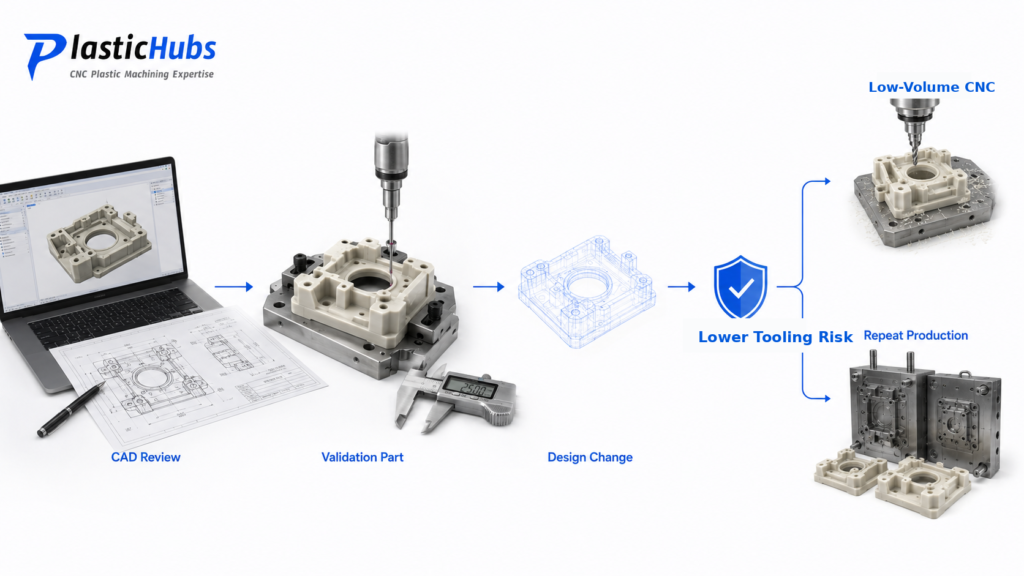
Many plastic parts should not move directly from CAD to mold. CNC machining can act as a controlled checkpoint before tooling.
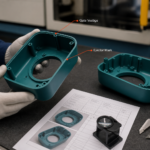
A machined plastic prototype can validate hole locations, mating surfaces, sealing faces, sliding features, bearing contact, threaded features, assembly sequence, ergonomic fit, chemical exposure, thermal exposure, and electrical insulation.
These are exactly the problems that become expensive after the mold is built. If a hole needs to move or a snap-fit needs to change after sampling, the project may require mold rework, new samples, added cost, and schedule loss.
After CNC validation, the design still needs molding review. Engineers should check draft, wall thickness, ribs, bosses, radii, gate location, parting line, ejector marks, sink risk, warpage risk, and shrinkage compensation.
The correct workflow is not always CNC or molding. For many plastic components, the safer workflow is CNC first for proof, then injection molding when the design and demand are ready.
What to Prepare Before Requesting a Quote
A useful quote request should help the supplier evaluate the correct process, not only price the CAD file.
Send the following information before asking for plastic CNC machining, plastic injection molding, or both:
| Information to Provide | Why It Matters |
| 3D CAD file, such as STEP or IGES | Defines the model geometry and helps the supplier review manufacturability. |
| 2D drawing | Identifies tolerances, datums, threads, surface finish, inspection points, and critical dimensions. |
| Target material or performance requirement | Prevents same-name plastics from being treated as equivalent. |
| Quantity now and expected future quantity | Helps compare prototype, low-volume, bridge, and production routes. |
| Design status | Shows whether the part is still changing or already after design freeze. |
| Function-controlling features | Identifies holes, sealing faces, threads, sliding surfaces, or datums that can reject the part. |
| Surface and cosmetic requirements | Defines tool marks, texture, transparency, color, polish, or molded appearance targets. |
| Application environment | Connects temperature, chemicals, moisture, friction, load, and cycles to material choice. |
| Inspection and acceptance method | Prevents a low-scope quote from appearing cheaper than a verified part. |
| Future molding plan | Allows the supplier to flag moldability issues during the CNC prototype stage. |
If the part may later move from CNC machining to injection molding, state that early. The supplier can then review the same part as both a machined component and a future molded component.
That early review can prevent the common mistake of validating a part by CNC, then discovering later that the geometry is not ready for molding.
PlasticHubs Process Review
PlasticHubs supports plastic CNC machining, plastic prototyping, and low-volume plastic part production for custom engineering applications.
If your plastic part is still being tested, revised, or ordered in low volume, start with a CNC machining review. This helps validate material behavior, fit, critical dimensions, surface requirements, and functional interfaces before mold investment.
If your design is already validated and the project is moving toward repeat production, PlasticHubs can also help review whether injection molding is the better long-term production route.
The goal is not to force every project into CNC machining. The goal is to choose the process that reduces total project risk and supports the next stage of the part.
FAQ: Plastic CNC Machining vs Plastic Injection Molding
Is plastic CNC machining cheaper than plastic injection molding?
For low quantities, plastic CNC machining is often cheaper because it does not require a mold. For high repeat quantities, plastic injection molding can become cheaper per part after tooling cost is spread across enough parts.
The break-even point depends on part size, material, mold cost, tolerance, finish, inspection, and expected future demand.
Is plastic injection molding faster than CNC machining?
For first parts, CNC machining is usually faster because no production mold is required. It can machine parts directly from available plastic stock.
After the mold is completed and qualified, injection molding is usually faster for repeat production because each cycle can produce one or more parts.
Can CNC plastic parts replace injection molded parts?
They can replace molded parts for prototypes, low-volume production, bridge runs, replacement parts, and custom engineering components.
They are usually not the best long-term replacement for mature high-volume molded parts where low unit cost and repeated output are the main goals.
Should I CNC machine a plastic part before injection molding?
Often, yes. CNC machining can validate fit, assembly, hole locations, sealing surfaces, material behavior, and critical dimensions before mold investment.
It is especially useful when the design may still change or when mold rework would be expensive.
Do CNC-machined plastic parts and injection molded parts use the same material?
Sometimes they use the same material family, such as ABS, PC, POM, nylon, or PEEK. But the exact grade, filler content, stock form, shrinkage behavior, moisture condition, and processing history may be different.
Do not assume a CNC-machined plastic stock and an injection molding resin behave the same just because the material name is similar.
Which process is better for tight tolerances?
Plastic CNC machining is often better for tight local features when the material is stable, the geometry is accessible, and the part can be fixtured and inspected correctly.
Injection molding can be highly repeatable after the mold and process are qualified, but molded-part tolerance must account for shrinkage, cooling, wall thickness, gate location, and resin behavior.
Which process is better for cosmetic plastic housings?
Injection molding is usually better for high-volume cosmetic housings with molded texture, ribs, bosses, snap-fits, and consistent exterior surfaces.
CNC machining can still be useful for early appearance checks, fit validation, and functional prototypes before tooling.
What is the safest process when the design is not final?
Plastic CNC machining is usually safer when the design is not final. It allows the team to test and revise the part without committing to mold fabrication.
Injection molding should usually wait until the drawing, material, key dimensions, and cosmetic requirements are stable.
When should injection molding be quoted alongside CNC machining?
Request an injection molding comparison when the design is stable, the expected quantity can justify tooling, and molded-part behavior is part of the production requirement.
The comparison should include tooling cost, sampling time, mold-rework risk, part cost, inspection scope, and expected lifetime demand.
What should I send for a plastic CNC machining quote?
Send the CAD file, 2D drawing, material grade, quantity, critical dimensions, surface requirements, application environment, and inspection needs.
If the part may later move to injection molding, mention that in the quote request so the supplier can review both CNC manufacturability and future moldability.