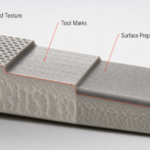
Acrylic CNC machining turns PMMA sheet, plate, rod, or block into accurate plastic parts with pockets, holes, curved surfaces, sealing lands, and other features that cannot be made by simple profile cutting alone. It is a practical route for prototypes and production quantities of transparent covers, display parts, light guides, instrument windows, manifolds, and custom housings.
The process is precise, but clarity is not automatic. The stock grade, cutter condition, chip evacuation, workholding, geometry, and finishing sequence all affect whether a part leaves the shop clear and controlled or chipped, cloudy, stressed, or rounded where it should remain flat.
For most buyers, the useful questions are simple: Which acrylic stock should be specified? Does the geometry suit CNC machining? Which surfaces must remain functional, and which must look clear? The answers should be settled before machining and polishing are quoted as separate line items.
When CNC machining is a good fit for acrylic parts
CNC machining is a good fit when an acrylic part needs accurate features on several faces, a specified PMMA stock grade, or design changes that do not justify dedicated tooling. It can combine a profiled outline with bores, counterbores, recesses, threads, engraving, and three-dimensional features in one part.
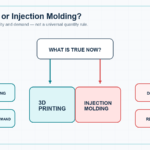
That makes machining different from laser cutting, which is strongest on sheet profiles and engraved surfaces. It also differs from injection molding, which can repeat complex shapes efficiently after tooling is built but requires a stable molded design.
CNC is often the sensible starting point when:
- the part needs accurate features on more than one face;
- the design may change before tooling is justified;
- a named PMMA stock grade must be tested;
- functional dimensions and cosmetic surfaces must coexist;
- the quantity does not support dedicated molding tools.
The process still has geometric limits. Round cutting tools leave radii in internal corners, deep narrow pockets restrict chip removal, and thin unsupported features can move under clamping or cutting force.
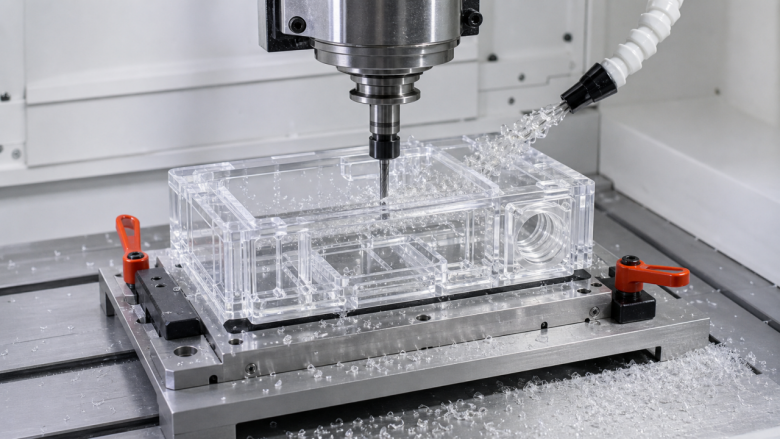
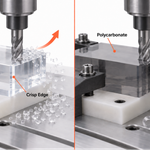
Figure 1. Stable workholding, sharp cutting, and chip evacuation matter as much as the programmed toolpath.
Choose cast or extruded acrylic before the drawing is final
Cast and extruded acrylic are both PMMA, but they are made differently and do not always behave the same during machining, polishing, bonding, or assembly.
Cast acrylic
Cast acrylic is commonly selected for machined parts with demanding cosmetic or optical surfaces. It is often easier to finish cleanly and can be a good starting point for thicker custom parts, display components, transparent fixtures, and optical prototypes.
The word “cast” does not guarantee the finished result. Thickness variation, grade, storage, and the specific finishing route still need to be considered.
Extruded acrylic
Extruded acrylic is widely available and can provide economical, consistent sheet stock for many covers, guards, and display components. Depending on the grade and operation, it may be more sensitive to heat, smearing, or stress effects during cutting and polishing.
If a project includes solvent bonding, flame polishing, tight fasteners, or critical optical zones, qualify the actual stock rather than treating “acrylic” as a complete material specification.
The purchase package should identify the PMMA grade, cast or extruded form when relevant, color or tint, stock thickness, and any traceability requirement. This decision belongs in the material callout—not in an email after parts have already been cut.
How a machined acrylic part moves from CAD to inspection
The supplier first reviews the CAD model and drawing for tool access, workholding, fragile edges, tolerances, and finish zones. Raw stock is then cut to size and supported so that it is held securely without being distorted.
Roughing removes most of the material while leaving the part stable. Finishing passes create the final dimensions and surface on critical features. Drilling, threading, engraving, or multi-side operations follow in an order that protects thin walls and visible faces.
The machining setup should keep chips moving away from the cut. When chips are trapped and cut again, they add heat and can mark the surface. A sharp tool should cut rather than rub; unnecessary dwell in one area works against both clarity and dimensional control.
After machining, the part is cleaned, inspected, and routed only to the finish operations required by the drawing. Functional dimensions that may be affected by polishing, coating, or assembly are checked after the last relevant operation.
Design choices that protect clarity and dimensions
Good acrylic design is less about applying one universal wall-thickness rule and more about controlling stress, support, and access.
Use internal radii that allow a practical cutter to enter the feature. Avoid deep narrow cavities when the same function can be achieved with a more open shape. Keep holes and notches away from fragile unsupported edges, and use gradual transitions where a sharp change would concentrate load.
Fasteners deserve special attention. A tight screw, a countersink with poor contact, or a heavily loaded thread cut directly into PMMA can create local stress. Clearance holes, washers, inserts, or through-bolts may spread the load more effectively, depending on the assembly.
Separate appearance from function on the drawing. A visible edge may need polishing, while a sealing land, datum, bond area, or mating face may need to remain flat and as-machined. If every surface receives the same cosmetic instruction, the finish process can change the very geometry that controls fit.
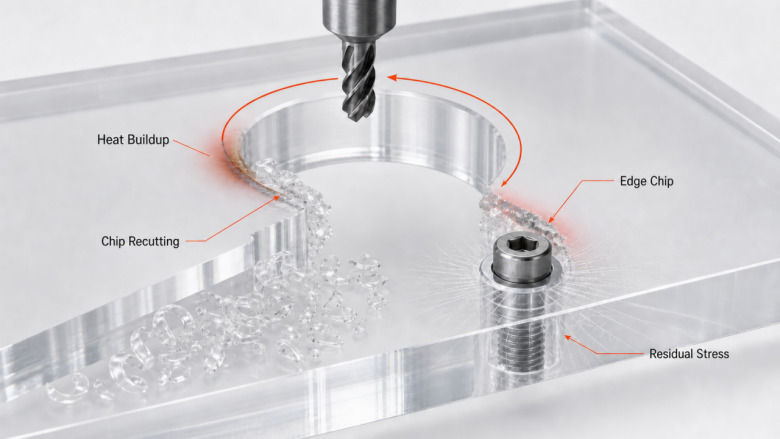
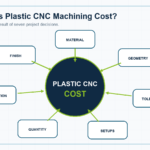
Figure 2. Heat buildup, chip recutting, unsupported edges, and assembly stress can all affect a clear PMMA part.
Finishing options for machined acrylic parts
Machined acrylic can be left as-machined, mechanically polished, flame polished, treated with a compatible specialized process, or printed, painted, or coated. The appropriate route depends on which surfaces need a visual change and which dimensions, edges, bond areas, or mating faces must remain protected.
| Finish route | What it can improve | What must be protected |
| Mechanical polishing | Accessible faces and edges; gradual control of appearance | Dimensions, crisp edges, flat sealing or bonding zones |
| Flame polishing | Rapid clarification of exposed edges on suitable parts | Heat-sensitive features, stressed areas, sharp detail |
| Specialized chemical or vapor treatment | Selected surfaces where the material and process are compatible | Dimensions, stress state, bonding, and safe process control |
| Printing, painting, or coating | Color, graphics, opacity, or added surface function | Masked zones, adhesion, cure conditions, and fit |
“Optically clear” is also incomplete as an acceptance note. It should identify the viewing zone, lighting, background, viewing distance, and whether an approved sample controls the result. A transparent cover does not need the same visual standard on a hidden mounting flange and on the window through which an operator reads an instrument.
Acrylic or polycarbonate?
PMMA is often favored when clarity, surface appearance, and outdoor visual stability are the leading requirements. Polycarbonate is usually considered when impact resistance and toughness are more important.
The choice is not simply “clear versus strong.” Thickness, coating, cleaning chemicals, operating temperature, fastening, and the consequences of breakage can change the answer. A machine guard exposed to repeated impact may point toward polycarbonate; a polished display window or light-handling part may point toward acrylic.
If the material decision remains open, compare named grades under the actual service conditions. The PlasticHubs polycarbonate machining guide is a useful next step when impact and assembly stress may outweigh the surface advantages of PMMA.
Specify how the part will be judged
Dimensional inspection and cosmetic inspection answer different questions. Use datums and tolerances for fit, then mark optical, cosmetic, edge, bond, sealing, and non-visible zones separately.
An approved sample can be more reliable than a phrase such as “scratch-free.” The sample, lighting, viewing angle, background, and allowed handling marks should all be agreed before the batch is finished.
If the part will be bonded, cleaned, or assembled under load, include that operation in qualification. Stress that is invisible at incoming inspection may appear after solvent exposure or fastening.
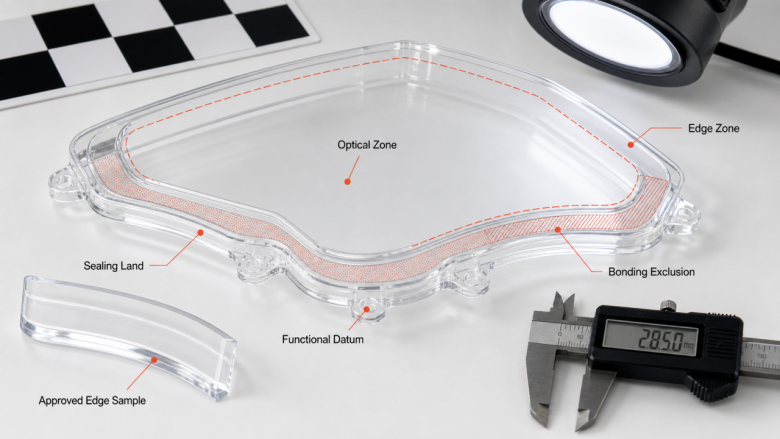
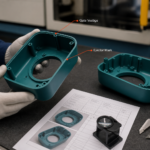
Figure 3. Zone-based requirements keep cosmetic work from changing functional geometry.
Frequently asked questions about acrylic CNC machining
Can CNC machining make acrylic completely transparent?
Machining can create accurate transparent parts, but an as-machined face normally retains some tool pattern. The required clarity depends on stock, cutting quality, geometry, and a suitable finishing route. Define the viewing zone and approval method instead of assuming that all machined faces will look the same.
Is cast acrylic always better than extruded acrylic?
No. Cast acrylic is often selected for demanding machined and cosmetic parts, while extruded sheet can be practical and economical for many applications. The right choice depends on grade, thickness, geometry, finishing, bonding, and service conditions.
Can acrylic be threaded?
Threads can be machined in acrylic, but their suitability depends on load, engagement, assembly frequency, and local stress. Inserts, clearance holes, or through-fasteners may be safer for repeated or highly loaded assembly.
Which file information helps an acrylic quote?
Provide 3D CAD, a revision-controlled drawing, PMMA grade and stock form, quantity, critical dimensions, optical or cosmetic zones, finishing requirements, assembly conditions, inspection method, and packaging needs.
Review an acrylic part with PlasticHubs
PlasticHubs can review the material, geometry, machining route, finish zones, and inspection plan as one manufacturing problem. Explore our plastic CNC machining capability, then send the CAD model, drawing, material requirement, quantity, and finish expectations through the PlasticHubs engineering contact.
The value of the review is not a generic feed-and-speed recommendation. It is a clearer manufacturing route that protects the surfaces the customer sees and the features the assembly depends on.