CNC Plastic Machining: Materials, Tolerances & DFM Guide
A plastic part can change shape during clamping, cutting, or after release from the fixture. Material choice and machining conditions therefore need to be reviewed together.
Plastic CNC machining starts with the specified resin and grade, the features that must fit, and the conditions in which the part will be used. This guide covers material selection, achievable tolerances, DFM checks, and process alternatives.
For custom plastic machining or CNC plastic prototypes, identify what the part must demonstrate: assembly fit, wear, insulation, appearance, or behavior in its operating environment. Those requirements help decide whether machining from stock is appropriate.
PlasticHubs supports this work with plastic-focused DFM, material guidance, CNC milling, CNC turning, 5-axis machining, inspection planning, and project-specific manufacturing review.
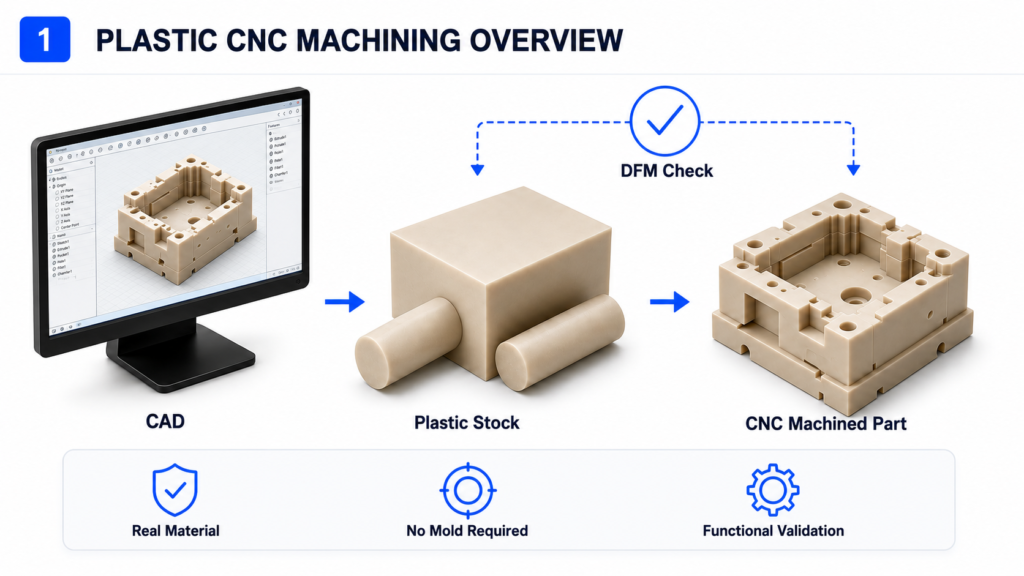
Plastic CNC Machining at a Glance
| Decision Area | What Engineers Need to Know | Practical Meaning |
| Process | Subtractive machining from plastic sheet, rod, plate, or block using CNC milling, CNC turning, drilling, and 5-axis machining when needed | Best for accurate functional parts made from real engineering plastics |
| Best-fit use cases | Functional prototypes, low-volume plastic parts, pilot builds, fixtures, housings, bushings, insulators, and pre-tooling validation | May avoid mold-tooling investment for low-volume work; compare total project cost at the expected quantity |
| Common materials | ABS, PC, POM (acetal), Nylon, PEEK, PTFE, Acrylic/PMMA, PVC, PE, PP | Material choice affects tolerance, finish, heat response, moisture behavior, and dimensional stability |
| Typical part types | Machined plastic housings, brackets, spacers, bushings, rollers, covers, gears, manifolds, and electrical insulators | Works for both plastic CNC milling and plastic CNC turning |
| Key risks | Thin-wall deflection, burrs, heat buildup, clear plastic chipping, moisture movement, internal stress, and tolerance drift | Plastic machining needs plastic-specific DFM, not metal machining assumptions |
| Choose another process when | Geometry is highly organic, volume is high, molded texture is required, or flexible elastomer behavior matters | 3D printing, vacuum casting, injection molding, or silicone overmolding may be better |
What Is Plastic CNC Machining?
Plastic CNC machining is a subtractive manufacturing process that cuts solid plastic stock into custom parts using computer-controlled machine tools. The process can include CNC milling, CNC turning, drilling, tapping, boring, and 5-axis machining for complex plastic features.
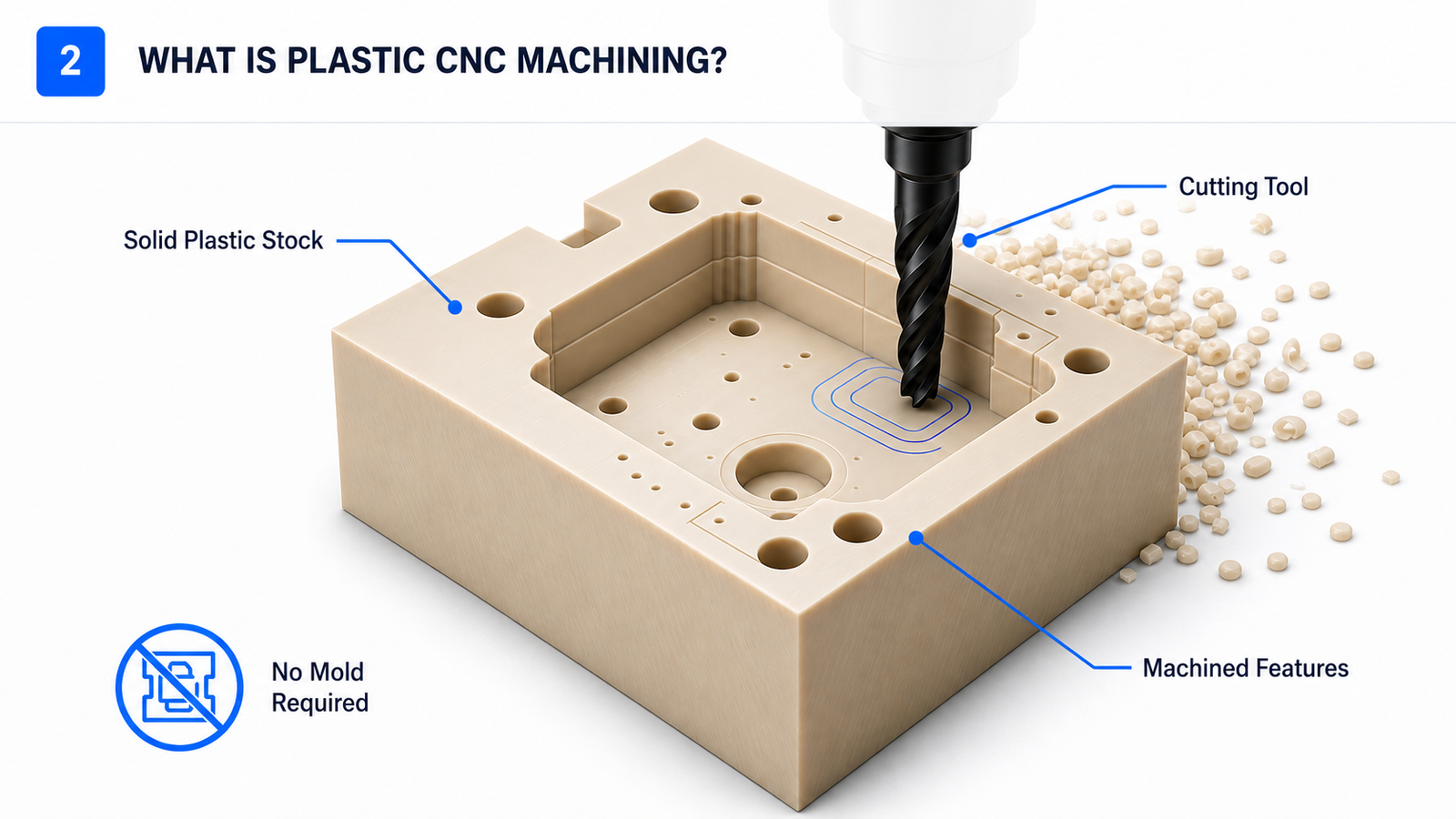
Unlike injection molding, CNC machining does not require a dedicated mold, although it still needs cutting tools and may need custom fixtures. Engineers often choose it for functional prototypes and small batches before committing to mold tooling.
Plastic CNC machining is also different from metal CNC machining. Compared with common machinable metals, engineering plastics are typically less stiff and more sensitive to cutting heat, clamping force, and post-machining movement. Chip behavior and the degree of sensitivity depend on the resin and grade.
How Plastic CNC Machining Works
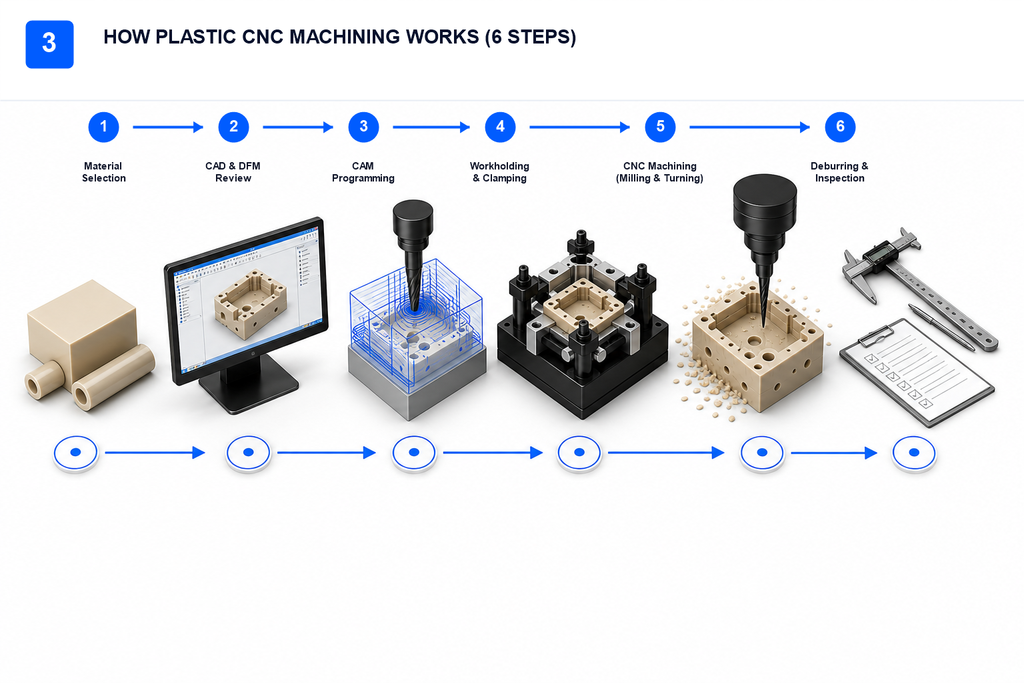
Step 1: Material Selection
Material selection comes first because plastics do not machine the same way. POM, Nylon, PEEK, PTFE, Acrylic, PC, ABS, and PVC each respond differently to cutting heat, tool pressure, clamping, burr formation, and finishing.
The selected material should match the part’s load, wear, friction, electrical insulation, temperature, chemical exposure, appearance, and tolerance requirement. A wrong material can create machining problems even when the CAD design is acceptable.
For example, POM is often selected for low-friction and dimensionally stable parts, while Nylon is often selected for toughness and wear resistance. PEEK is used for higher-performance applications, but it requires tighter process control because the stock material is expensive and machining mistakes are costly.
Step 2: CAD Review and DFM Feedback
A good plastic CNC project should not move directly from CAD to machining. The model should be reviewed for wall thickness, feature support, sharp internal corners, deep pockets, small holes, threads, tolerance stack-up, surface finish, and material-process fit.
DFM checks whether features that look acceptable in CAD can remain supported during cutting and clamping, be inspected, and fit during assembly.
Confirm the manufacturing route during DFM. Tool access, material requirements, quantity, and surface expectations may favor CNC machining, 3D printing, vacuum casting, injection molding, or silicone overmolding.
Step 3: CAM Programming and Toolpath Control
CAM programming defines how the cutting tool removes material. For plastic, the toolpath must manage heat buildup, chip evacuation, tool engagement, burr control, and surface quality.
Sharp tools, stable cutting engagement, and proper chip removal are critical. If the tool rubs instead of cutting, the material can melt, smear, chatter, or shift dimensionally.
Toolpath strategy also affects thin features. A thin plastic wall can deflect under cutting pressure, then move again after the part is released from the fixture.
Step 4: Workholding and Deformation Control
Workholding is one of the most common sources of plastic CNC machining problems. Too much clamping pressure can deform the stock before cutting begins.
Thin walls, soft plastics, large flat panels, and flexible features need stable support. The fixture must hold the part without crushing it, bending it, or locking stress into the material.
For critical parts, fixture strategy is as important as cutting strategy. A well-programmed toolpath cannot fix a part that moves during machining or changes shape after unclamping.
Step 5: CNC Milling, CNC Turning, Drilling, and 5-Axis Machining
Plastic CNC milling is used for prismatic parts, flat faces, slots, pockets, housings, brackets, plates, and complex milled features. It is often the main process for custom plastic machining and CNC plastic prototype work.
Plastic CNC turning is used for round or cylindrical plastic parts. Common examples include bushings, spacers, rollers, sleeves, pins, knobs, and threaded plastic components.
5-axis plastic machining can reduce setups and improve tool access for complex parts. It is useful when the geometry requires angled features, multi-face machining, or tighter alignment across several surfaces.
Step 6: Deburring, Finishing, Inspection, and Validation
Plastic parts often need deburring after machining. Burr behavior depends on the material, tool sharpness, feature geometry, and edge requirement.
Finishing may include polishing, vapor polishing or smoothing where suitable, painting, laser marking, engraving, screen printing, or annealing when material and geometry allow. Clear plastic parts may need extra finishing control because scratches, chips, and stress marks are easy to see.
Inspection should focus on critical-to-function dimensions. Hole position, flatness, thread quality, perpendicularity, assembly datums, sealing surfaces, and mating features usually matter more than cosmetic dimensions.
Common Plastic CNC Machining Materials
| Material | Why Engineers Choose It | Main Machining Risk | Common CNC Plastic Parts |
| ABS | General-purpose prototypes, housings, covers, moderate toughness | Burrs, heat softening, surface marks | Housings, covers, brackets, fixtures |
| PC / Polycarbonate | Impact resistance, transparent or translucent parts, protective covers | Scratching, chipping, stress marks | Windows, guards, covers, protective panels |
| POM / Acetal (specify grade) | Low friction, dimensional stability, wear resistance | Burr control and sharp edge quality | Bushings, gears, rollers, spacers |
| Nylon / PA | Toughness, wear resistance, sliding parts | Moisture absorption and dimensional movement | Wear pads, bushings, rollers |
| PEEK | High temperature, chemical resistance, high-performance applications | High material cost and difficult machining | Medical, aerospace, high-load parts |
| PTFE | Low friction, chemical resistance, non-stick behavior | Softness, creep, deformation during clamping | Seals, insulators, sliding parts |
| Acrylic / PMMA | Optical clarity and cosmetic parts | Brittle chipping, cracking, polishing difficulty | Transparent panels, display parts |
| PVC | Chemical resistance and industrial plastic parts | Heat control and edge quality | Chemical handling parts, panels |
| PE | Chemical resistance, toughness, low friction | Flexibility and dimensional movement | Guides, wear strips, sliding components |
| PP | Chemical resistance, lightweight parts, low-cost functional parts | Softness, burrs, clamping deformation | Chemical-resistant covers, panels, blocks, simple fixtures |
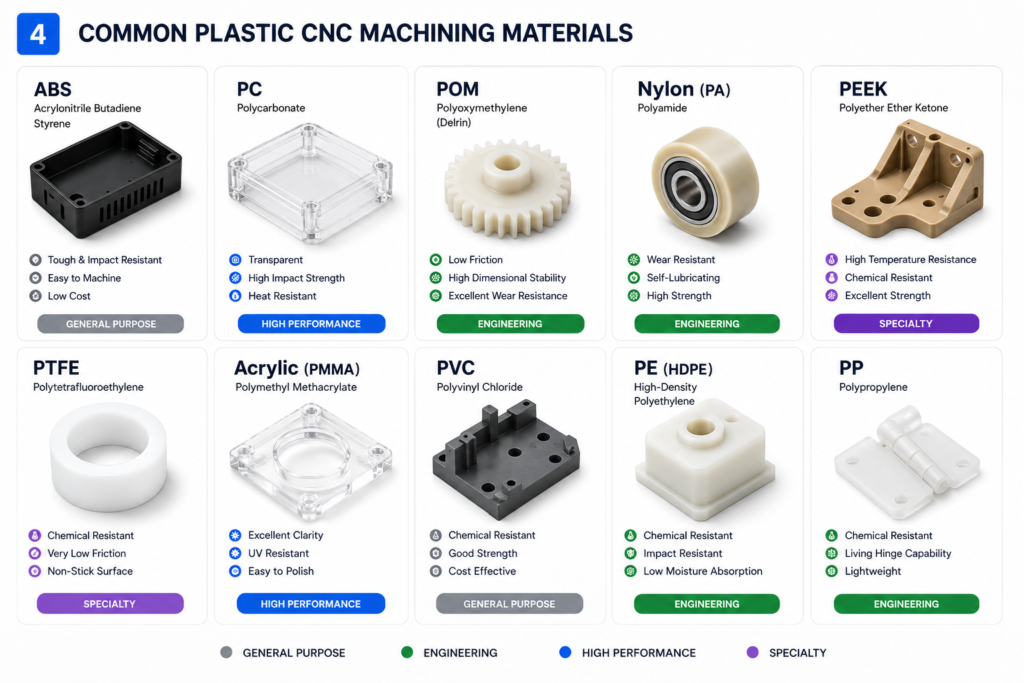
Material Selection Notes for CNC Plastic Parts
These machinable plastics—POM, Nylon, PEEK, PTFE, Acrylic, PC, ABS, PVC, PE, and PP—are not interchangeable. Choose the resin and grade against load, wear, friction, temperature, moisture, chemical contact, appearance, and functional tolerance requirements.
For sliding or wear parts, POM, Nylon, PTFE, and PE are common starting points. For clear covers, windows, and protective panels, Acrylic and PC are more common, but both need careful toolpath and finishing control.
For high-performance plastic parts, PEEK is often selected for demanding thermal, chemical, or mechanical conditions. Because PEEK stock is expensive, early DFM review is important before machining.
For soft or flexible plastics such as PTFE, PE, and PP, workholding and deformation control matter more than many engineers expect. These materials can move under clamping pressure, so unsupported thin features should be reviewed before production.
Plastic-Specific Machining Risks Engineers Should Watch For
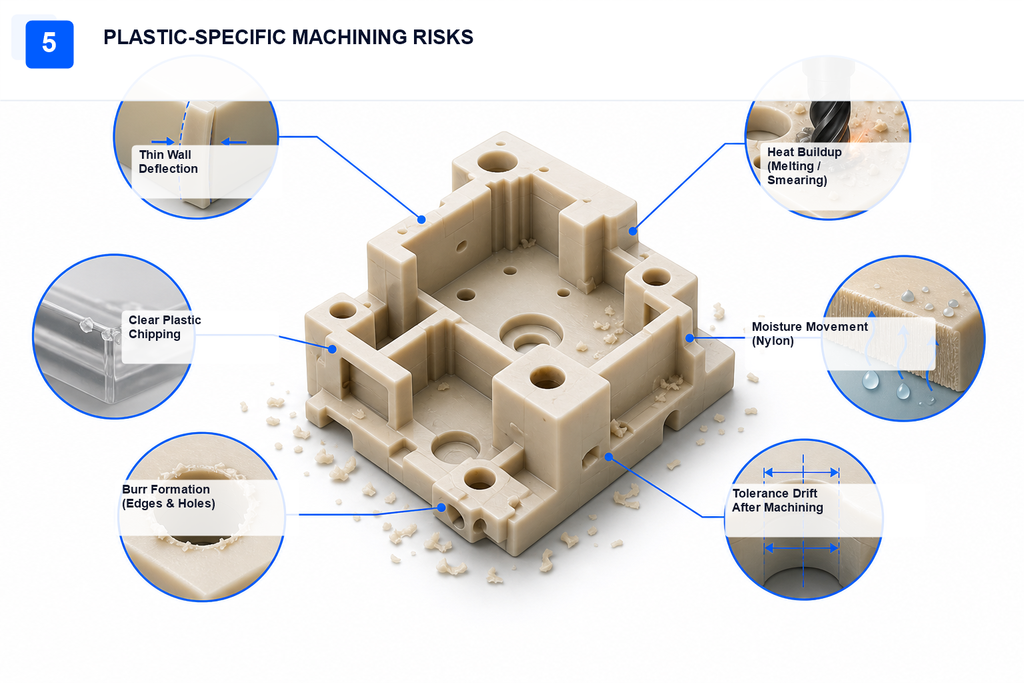
Thin-Wall Movement
Thin plastic walls can deflect during cutting. The cutter may follow the programmed path, but the wall can move away from the tool and settle into a different position after machining.
This creates a common inspection problem. The part may appear close to target during setup but fail final measurement after unclamping.
Thin walls should be reviewed early. Support features, wider tolerances, different machining sequences, or fixture changes may be needed.
Heat Buildup
Plastics usually conduct heat less effectively than metals. Heat can stay near the cutting zone and cause melting, smeared edges, poor surface finish, or dimensional drift.
Heat problems often come from dull tools, poor chip evacuation, excessive tool engagement, or rubbing. The cutter must shear the material cleanly instead of heating it.
For heat-sensitive plastics, cutting strategy has a direct effect on tolerance and appearance. Cooling, air blast, tool geometry, and feed strategy should be selected with the material in mind.
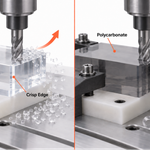
Clear Plastic Chipping
Clear plastics such as Acrylic and Polycarbonate show defects easily. Small chips, scratches, haze, stress marks, and polishing inconsistencies can make a transparent part fail cosmetic review.
Clear parts should not be treated like standard opaque functional parts. The inspection criteria must include appearance, not only dimensions.
If the part is used as a window, display cover, or protective guard, surface expectations should be defined before machining starts.
Nylon Moisture Sensitivity
Nylon can absorb moisture from the environment. This can affect dimensions after machining and after the part enters its operating environment.
The risk is higher when the part has tight fits, sliding contact, press fits, or critical hole positions. Inspection results may not fully represent how the part behaves later.
Material conditioning and tolerance planning should be discussed when Nylon is used for precision features.
PEEK Machining Difficulty
For PEEK parts, review tool wear, heat control, stock cost, and dimensional requirements before choosing the machining plan.
A failed PEEK part is expensive because the material itself is costly. Rework may also be difficult if the geometry is small, thin, or highly toleranced.
PEEK parts should move through DFM before production. The goal is to reduce uncertainty before material is committed to the machine.
Burrs, Threads, and Small Holes
Plastic burrs behave differently from metal burrs. Some plastics form soft burrs that fold over the edge, while others chip or crack near the feature.
Small holes, threads, thin slots, and sharp internal features are common problem areas. Tool selection, drill strategy, tapping method, and deburring access all affect quality.
Threaded plastic parts should also be reviewed for assembly load. Inserts may be better when the part needs repeated fastening or higher thread strength.
Tolerance Mismatch
Over-tight tolerances are a frequent source of cost and delay. A tolerance that looks harmless on a drawing can create fixture complexity, inspection burden, and machining risk.
The tolerance scheme should follow function. Bearing fits, sealing surfaces, assembly datums, and hole positions may need tight control, while non-critical surfaces can often accept wider tolerance.
This is where DFM helps. It aligns the drawing with the material, geometry, process, and inspection method before the part is made.
When Should You Use Plastic CNC Machining?
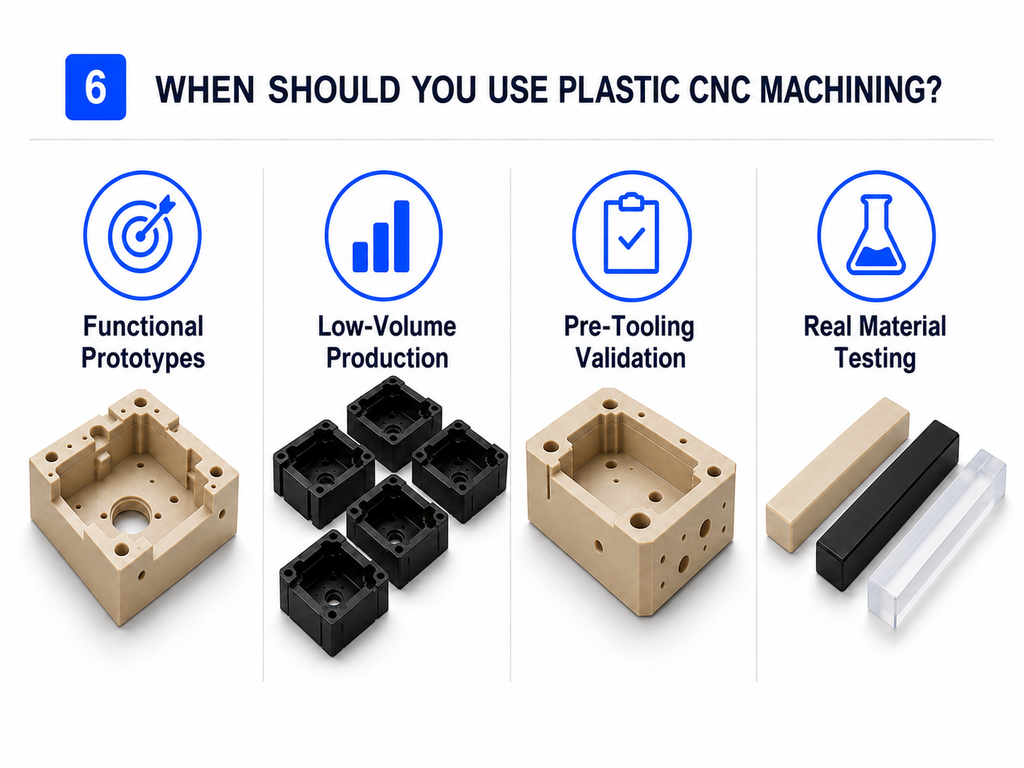
Use CNC Machining for Functional Prototypes
Plastic CNC machining is a strong choice when the prototype must behave like the final engineering plastic. This matters when the team needs to test load, friction, insulation, heat exposure, chemical resistance, fastening, or assembly fit.
3D printed prototypes can be useful early in development, but printed materials may not represent the final plastic. Machining from a specified stock grade can provide relevant feedback when the test depends on that material; check whether the available printed grade also meets the test requirements.
This is why CNC plastic prototype work is common before tooling. It helps teams validate the part before committing to injection mold cost and lead time.
Use CNC Machining for Low-Volume Plastic Parts
CNC machining does not require a mold, so it fits low-volume production, pilot builds, spare parts, jigs, fixtures, and bridge production. It is also useful when the design may still change.
For small batches, the tooling cost of injection molding may not be justified. CNC machining can produce functional parts directly from engineering plastic stock.
This is especially useful for NPI teams that need parts for validation builds, customer samples, field testing, or early production support.
Use CNC Machining Before Injection Molding
Injection molding is efficient at scale, but tool changes can be expensive. CNC machining helps validate geometry, tolerance stack-up, assembly fit, fastening points, and material behavior before mold investment.
A machined plastic part will not replicate every molded feature, texture, gate mark, or production behavior. It can still reveal many design issues before tooling starts.
Use CNC Machining When Real Material Behavior Matters
Real plastic stock matters when the part must be tested under mechanical, thermal, electrical, chemical, or wear conditions. Printed resin and casting resin may not match the target engineering plastic.
CNC machining supports functional validation in materials such as POM, Nylon, PEEK, PTFE, PC, Acrylic, ABS, PVC, PE, and PP. This makes it valuable when the test result depends on material behavior.
Select the prototype process against the test objective and the available material grade. A machined stock part may help assess material-dependent behavior, but it will not reproduce every property or feature of a molded production part.
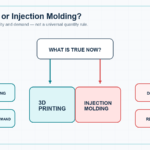
Plastic CNC Machining vs 3D Printing, Vacuum Casting, Injection Molding, and Silicone Overmolding
| Process | Best For | Strength | Limitation | Choose Plastic CNC Machining Instead When |
| Plastic CNC Machining | Functional prototypes, low-volume parts, engineering plastic components | Real stock material, good dimensional control, no mold cost | Less efficient for very high-volume production or highly organic geometry | Material behavior, tolerance, and functional validation matter |
| 3D Printing | Early design iteration, complex shapes, visual models | Fast geometry iteration and design freedom | Printed materials may not match final engineering plastics | The test requires a specified stock grade or features that suit machining and inspection |
| Vacuum Casting | Small batches with molded-like appearance | Good for cosmetic prototypes and soft tooling runs | Polyurethane behavior may not match the target production plastic | You need specific engineering plastic properties |
| Injection Molding | High-volume production with stable design | Can reduce unit cost when a stable design and production quantity justify tooling | Tooling cost, tooling lead time, mold correction risk | The design is not validated or the volume is still low |
| Silicone Overmolding | Soft-touch, sealing, grip, or elastomeric features | Useful for multi-material soft features | Not a replacement for rigid plastic CNC parts | The part needs rigid engineering plastic geometry |
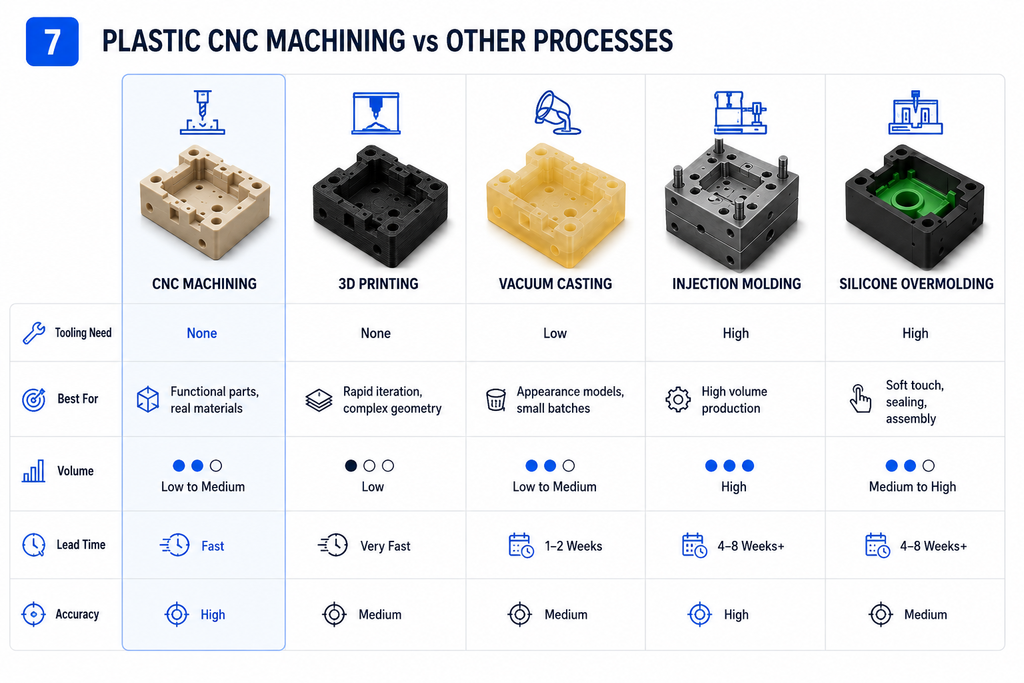
Plastic CNC Machining vs 3D Printing
3D printing is often better for early design iteration, complex shapes, and quick visual models. It can produce geometry that is difficult or impossible to machine.
Machining is useful when the test requires a specified stock grade or features that will be cut and inspected. Compare the actual printed and stock materials, achievable dimensions, surface requirements, and test conditions before selecting either process.
Plastic CNC Machining vs Vacuum Casting
Vacuum casting is useful for small batches with molded-like appearance. It can be suitable for sales samples, cosmetic prototypes, and short runs where polyurethane properties are acceptable.
Plastic CNC machining is better when the part must use a specific engineering plastic. POM, Nylon, PEEK, PTFE, PC, Acrylic, ABS, PVC, PE, and PP each provide material behavior that casting resin may not match.
Plastic CNC Machining vs Injection Molding
Injection molding is usually the right choice when the design is stable and the volume supports tooling. It provides strong unit economics at scale and consistent production once the mold is validated.
Plastic CNC machining is better before the design is frozen. It avoids mold investment and supports faster design changes during validation.
Many teams use both processes in sequence. CNC machining supports prototype and pilot validation, then injection molding takes over when design and volume are ready.
Plastic CNC Machining vs Silicone Overmolding
Silicone overmolding is used for soft-touch surfaces, seals, grips, gaskets, and multi-material features. It is not a replacement for rigid CNC plastic parts.
Plastic CNC machining is better for rigid engineering components with controlled geometry. Silicone overmolding is better when the function depends on elastomeric behavior.
Some projects need both. A rigid CNC plastic component may be used to validate the base geometry before overmolding or production tooling is planned.
When Plastic CNC Machining Is Not the Right Process
High-Volume Parts with Stable Design
If the design is frozen and the volume supports tooling investment, injection molding is usually more suitable. CNC machining can become less efficient when the same part must be made in very large quantities.
CNC machining can still support early builds, spare parts, or bridge production. It should not be forced into a role where molding is clearly the better long-term process.
Highly Organic Geometry or Internal Lattice Structures
CNC machining requires tool access. If the part has internal channels, lattice structures, sculpted organic surfaces, or geometry that cannot be reached by cutting tools, 3D printing may be better.
This is a geometry-driven decision. A part can be simple to print but difficult to machine if tool access is poor.
Molded Texture or Production Surface Replication
CNC machining can create accurate parts, but it does not fully replicate every molded texture, parting line, gate mark, or molded surface behavior. If production appearance is the main concern, injection molding or vacuum casting may be more appropriate.
This matters for consumer-facing parts. A prototype that passes dimensional inspection can still fail visual review if the surface expectation was never defined.
Soft Elastomeric Parts
Rigid plastic CNC machining is not the right process for soft-touch, gasket-like, rubber-like, or highly flexible parts. Silicone overmolding, urethane casting, or elastomer-specific processes may be better.
The decision should start with function. If the part must seal, flex, grip, or compress repeatedly, the material and process should match that behavior.
Plastic Machining Tolerances: What Engineers Should Know
Plastic machining tolerances depend on part geometry, material behavior, wall thickness, feature size, workholding, toolpath, surface finish, and inspection method. A rigid POM spacer and a thin PTFE seal do not behave the same way under cutting pressure.
Our CNC machining capability data supports CNC milling tolerances as tight as ±0.01 mm and CNC turning tolerances as tight as ±0.005 mm. For plastic parts, the practical tolerance plan should still be tied to the function of the part.
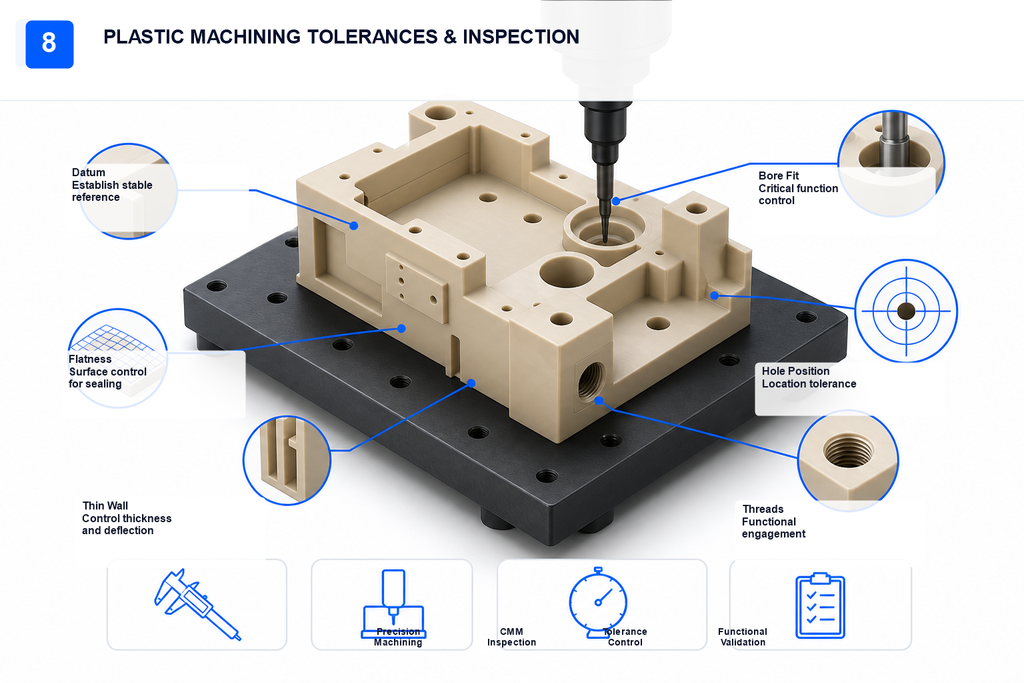
The best approach is to assign tight tolerances only where they matter. Functional interfaces, bearing fits, hole positions, sealing surfaces, and assembly datums should receive priority.
| Tolerance Area | Engineering Guidance |
| Bearing fits | Define material, mating part, load, and operating temperature |
| Hole position | Control datums and inspection method |
| Flatness | Review wall thickness, stock stress, and clamping |
| Threads | Check assembly load and repeat fastening requirements |
| Clear surfaces | Define both dimensional and cosmetic requirements |
| Thin walls | Review support, deformation, and inspection strategy |
| Non-critical surfaces | Use wider tolerances when function allows |
For NPI and pilot builds, inspection should match the part risk. CMM verification is valuable when the part has tight positional requirements, multiple setups, datum relationships, or critical assembly features.
Need to confirm a critical fit or tolerance before ordering? Send the drawing with the mating features and inspection requirements. Request a plastic CNC machining quote and tolerance review.
How DFM Reduces Plastic CNC Machining Risk
DFM checks whether the CAD model can become a stable physical part. For plastic CNC machining, it should review material choice, wall thickness, feature support, tolerance strategy, tool access, workholding, surface finish, and inspection needs.
A DFM review can identify issues before they cause re-quotes, failed prototypes, material waste, or delayed validation. It can also test whether CNC machining fits the project before production starts.
Include the agreed material, geometry, and inspection decisions in the production handoff so that the manufacturing team can act on the DFM findings.
Plastic CNC DFM Checklist
Review wall support, tool access, holes and threads, finishing, material behavior, tolerances, and the production route before releasing the CNC drawing.
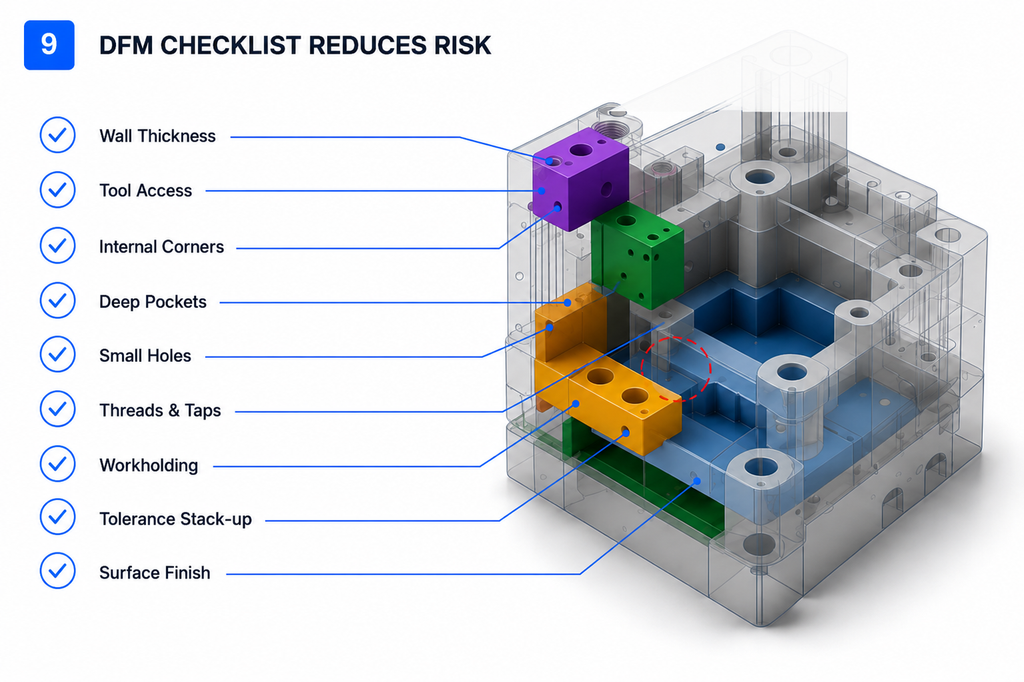
| DFM Check | Why It Matters |
| Thin walls | Reduces deflection and post-machining movement |
| Deep pockets | Checks tool reach, chatter, and internal corner limits |
| Sharp internal corners | Prevents impossible or high-cost toolpath requirements |
| Small holes and threads | Reduces breakage, burrs, and assembly failure |
| Clear plastic surfaces | Controls chipping, scratching, and polishing expectations |
| Nylon and moisture exposure | Reduces dimensional surprises after machining |
| PEEK machining plan | Reduces material waste and quality risk |
| PTFE clamping strategy | Reduces deformation and creep-related issues |
| Tolerance stack-up | Keeps tight tolerances on functional features only |
| Surface finish | Aligns machining output with cosmetic or functional needs |
| Production scaling | Checks whether CNC should remain the process or move to molding |
How to Choose a Plastic CNC Machining Supplier
Ask the supplier to identify unresolved material, tolerance, finish, and manufacturability questions alongside the price. Confirm who will resolve each issue before production.
Check Whether the Supplier Understands Plastic, Not Only CNC
A supplier that mainly machines metal may not automatically understand plastic-specific risks. Ask how they handle thin-wall support, clear plastic polishing, Nylon moisture behavior, PEEK machining, PTFE deformation, burr control, and plastic inspection.
The supplier should be able to discuss material behavior before quoting. If every plastic is treated the same way, the project risk is higher.
Check the Engineering Handoff and Manufacturing Accountability
Ask who confirms the resin and grade, reviews DFM findings, plans fixturing, performs inspection, and handles repeat builds. Whether production is in-house or coordinated, these responsibilities and the escalation path should be clear before ordering.
Request a named owner for critical dimensions, material traceability, drawing revisions, and changes between prototype and pilot build. Clear accountability matters more than a supplier-model label.
For an NPI project, ask how the prototype record, inspection requirements, and production revision will be carried forward if the manufacturing team changes.
Check Whether They Support Prototype-to-Production Work
Ask whether the supplier can support the stages your project needs: a single-part prototype, pilot build, small batch, repeat order, or later process transition. Confirm material, finishing, and inspection responsibilities at each stage.
Agree how design history, DFM decisions, and inspection records will be retained and handed over between stages.
Check Whether Quality Systems Are Visible
Ask which quality system applies to this order, how critical dimensions will be inspected, whether material identity and revisions are controlled, and what inspection record can be supplied. Request a certificate only when its scope and currency matter to the job.
For plastic parts, quality control should cover more than final dimensions. It should also consider burrs, surface finish, cosmetic expectations, deformation, and assembly fit.
Prepare a Plastic CNC Machining Inquiry for PlasticHubs
For a useful PlasticHubs project review, identify the part’s material, functional requirements, geometry, and acceptance criteria before requesting a production route.
PlasticHubs brings together instant quote access, AI/DFM feedback, factory-direct execution, self-operated manufacturing resources, and audited production capacity. Quality engineering, CMM verification, and ISO-backed quality systems support projects from no-MOQ prototypes through repeat production. For eligible CNC parts, lead times can start from 3 days; the quote confirms the route and schedule for the actual drawing.
Attach the CAD model and current drawing revision. Distinguish dimensions that affect fit from surfaces that only affect appearance, and note operating conditions that may change material behavior. Ask which requirements need clarification before the production route, lead time, and inspection documents are confirmed.
A project-specific review can surface material, geometry, and inspection questions before the first part is cut. Record those decisions with the quote so that a later revision or repeat order starts from the same requirements.
Get Plastic CNC Machining Feedback Before Production
Ready to move from CAD to a machined plastic part? Send your CAD model and drawing to PlasticHubs for a project-specific quote and DFM review. Include the resin and grade if known, quantity, fit-critical dimensions, finish, inspection requirements, and target delivery date.
If material selection or tolerances are still open, describe the operating conditions and mating features so those questions can be reviewed before production. PlasticHubs can review the project requirements and confirm the next step.
Request a Plastic CNC Machining Quote
Plastic CNC Machining FAQ
Which plastics can be CNC machined, and how should I choose?
Common options include ABS, acrylic (PMMA), polycarbonate (PC), POM, nylon, PEEK, PTFE, PE, and PP. Choose the exact resin and grade against the part’s load, wear, moisture, chemical, temperature, and appearance requirements. Confirm stock availability and machining behavior before freezing the drawing.
What tolerances are realistic for CNC-machined plastic parts?
Our CNC machining capability data includes milling tolerances as tight as ±0.01 mm and turning tolerances as tight as ±0.005 mm for suitable work. The tolerance for a particular plastic part depends on resin and grade, stock condition, wall thickness, geometry, fixturing, finishing, and measurement conditions. Mark critical features on the drawing so the quote and inspection plan can confirm the achievable result.
Can CNC-machined acrylic and polycarbonate parts remain clear?
They can be machined for transparent applications, but the required optical appearance is a separate finishing requirement. Chips, handling marks, stress and polishing can change the result. Specify the viewing surfaces and acceptance criteria; use a sample when appearance is critical.
When is CNC plastic machining preferable to 3D printing?
Consider machining when testing a part made from a specified plastic stock grade, checking critical fits, or making a small batch without a mold. Additive manufacturing may be preferable for rapid shape iteration or geometry that a cutting tool cannot reach. Compare the actual grade, shape, quantity, and test objective rather than assuming one process is always better.
When should a plastic part move from CNC machining to injection molding?
Revisit molding when the design is stable and expected volume can justify the tool and its lead time. Compare total cost at the forecast quantity, any expected design changes, material and finish requirements, and whether the machined prototype adequately represents the molded part.
What should I send for a CNC plastic machining quote?
Send the CAD model and a drawing that identifies the exact resin and grade, quantity, critical dimensions, finish, appearance, threads, and inspection requirements. Include service conditions such as temperature, moisture, chemicals, wear, or repeated assembly where relevant. This makes the DFM review and quote more specific.