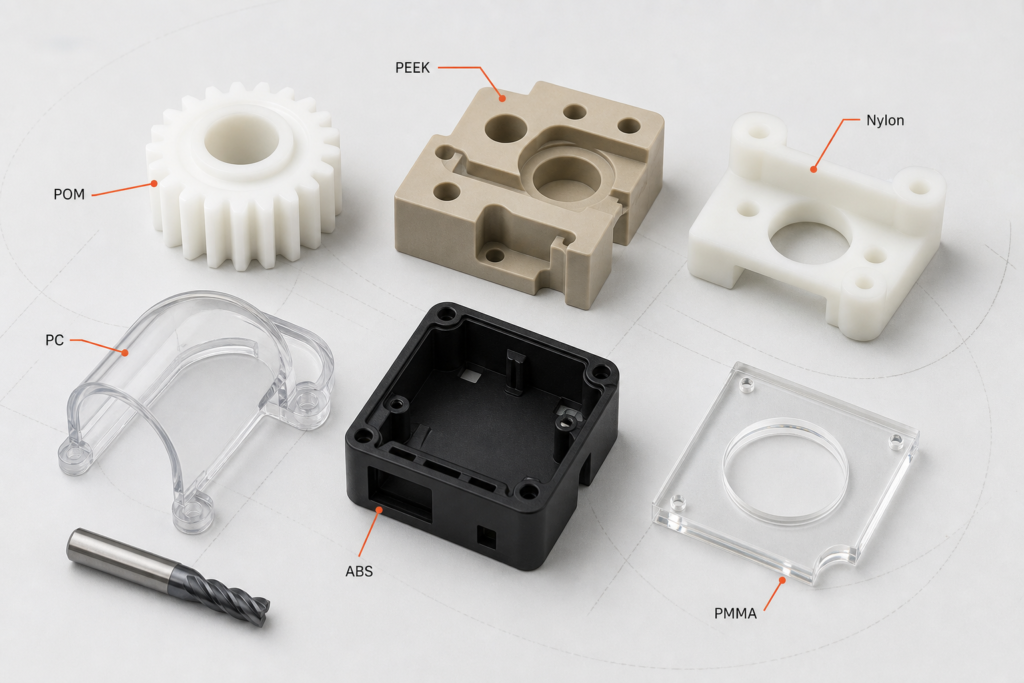
CNC-machined plastic material samples: POM, PEEK, Nylon, PC, ABS, and PMMA.
The best plastic for CNC machining is not the strongest, clearest, or most expensive material. It is the material that fits the part’s load, tolerance, temperature, friction, surface finish, assembly method, and service environment with the lowest risk of failure.
Engineers searching for best plastics for CNC machining usually do not need a simple ranking list. They need a selection rule: Will this part move after moisture exposure? Will a transparent component crack around fasteners? Is the cost of PEEK justified by the working conditions? Will Nylon lose fit accuracy after humidity changes?
For plastic part manufacturing projects like PlasticHubs, material selection cannot stop at “Can this plastic be machined?” A plastic part can machine successfully and still fail during assembly, inspection, shipping, or field use because of warping, cracking, haze, creep, or dimensional drift.
Why CNC Plastic Selection Is Different from Metal Selection
Metal parts often tolerate tight clamping, aggressive cutting, and narrow tolerance callouts better than plastic parts. Plastics are more sensitive to heat buildup, moisture absorption, residual stress, creep, thermal expansion, and clamping deformation.
This is where many CNC plastic machining projects go wrong. A tolerance that looks normal on an aluminum bracket may be unrealistic on a large Nylon spacer, thin PC cover, clear PMMA panel, or stress-sensitive PEEK component.
Plastic CNC machining materials should be reviewed before quotation, not corrected after machining. The review should include material grade, stock form, tolerance stack-up, surface finish, inspection method, and end-use conditions.
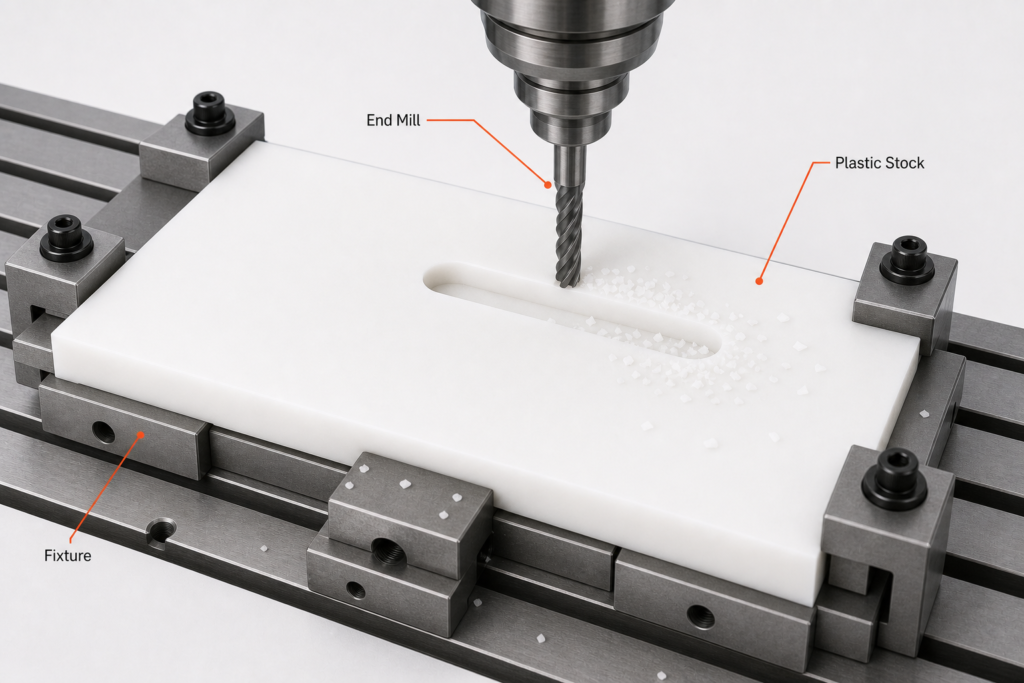
Plastic CNC machining uses controlled stock, fixturing, tooling, and chip control.
CNC Plastic Material Comparison: Best Use, Main Risk, and Buyer Decision Logic
| Material | Best For | Main Risk | Buyer Decision Logic | When to Avoid It |
| POM / Acetal | Gears, bushings, rollers, sliding blocks, precision functional parts | Not transparent; not for high-temperature applications | Review first when low friction, wear resistance, machinability, and dimensional stability matter | Avoid when the part needs transparency, high continuous heat resistance, or special compliance requirements |
| PEEK | High-temperature, high-load, chemical-resistant, high-value industrial parts | High material cost, machining cost, and blank waste | Use when the cost of part failure is higher than the cost of the material | Avoid when the application does not need high heat, chemical resistance, or long-term high-performance stability |
| Nylon / PA | Tough wear parts, spacers, bushings, impact-loaded components | Moisture absorption and dimensional change | Good for rugged parts; risky for tight humidity-sensitive fits unless grade and conditioning are controlled | Avoid for tight fits, press fits, long hole spacing, or humidity-sensitive dimensions without review |
| PC / Polycarbonate | Transparent guards, covers, shields, machine windows, impact-resistant parts | Machining stress, surface haze, solvent sensitivity | Choose when impact resistance matters more than perfect optical polish | Avoid when the part needs the highest cosmetic clarity or will face aggressive cleaning solvents |
| ABS | Low-cost prototypes, housings, fixtures, covers, display components | Lower heat and chemical resistance than engineering plastics | Good for early validation and cost-controlled parts, but not always the final-use material | Avoid for high heat, harsh chemicals, outdoor exposure, or long-term loaded parts |
| PMMA / Acrylic | Clear panels, light guides, display parts, cosmetic transparent components | Brittle cracking, fastener stress, lower impact resistance than PC | Choose for clarity and appearance, not impact abuse | Avoid when the part may be hit, dropped, clamped, or used as a protective shield |
A material table can help with first-pass selection, but it cannot replace DFM review. A plastic that looks suitable on a data sheet may still create problems during machining, assembly, inspection, or field use.
When we receive a CAD file and drawing, we check whether the material, geometry, tolerance, surface requirement, and service conditions work together. This helps reduce the risk of getting a fast quote for the wrong material.
Choose by Requirement: Friction, Heat, Transparency, Impact, Cost, or Tolerance
| Requirement | First Material to Review | Why | When to Switch |
| Low friction + wear resistance | POM / Acetal | Good sliding behavior, wear resistance, and stable machining behavior | Review PEEK if heat or chemical exposure is beyond POM’s range |
| High heat + chemical resistance | PEEK | Strong thermal, chemical, and mechanical performance | Do not over-specify PEEK when failure risk is low |
| Tough wear part with impact load | Nylon / PA | Good toughness and abrasion resistance | Review POM or controlled Nylon grades if humidity affects fit |
| Transparent impact guard | PC / Polycarbonate | Better impact resistance than PMMA for covers and shields | Review PMMA if appearance and edge clarity matter more than impact resistance |
| Clear cosmetic panel | PMMA / Acrylic | Better clarity and cosmetic potential when impact demand is low | Review PC if the part may be hit, dropped, or clamped |
| Low-cost prototype or housing | ABS | Practical cost, machinability, and early-stage validation | Switch to engineering plastic for heat, chemicals, outdoor exposure, or load |
| Tight mechanical fit | POM / Acetal | Often more stable than moisture-sensitive or highly stressed plastics | Recheck material if heat, load, or chemical exposure exceeds POM capability |
This table is useful for early material direction. Final selection still depends on part size, wall thickness, mating parts, inspection method, service temperature, humidity, chemical exposure, and assembly method.
POM CNC Machining: Best for Low-Friction Precision Parts
POM, also called acetal, is one of the most practical choices for precision functional plastic parts. It machines cleanly, holds detail well, and performs well in sliding or rotating components.
Typical POM CNC machining applications include gears, rollers, bushings, spacers, wear blocks, valve components, and mechanical guide parts. For parts that need low friction, wear resistance, and stable fit, POM is often one of the first materials to review.
POM is not the right material when the part must be transparent or exposed to high continuous heat. It also needs grade review when chemical exposure, food contact, wear additives, electrical behavior, or compliance requirements matter.
Engineering heuristic: Choose POM when the part needs sliding contact, moderate load, clean machining, and stable fit without transparency.
PEEK CNC Machining: Best for High-Cost Failure-Risk Applications
PEEK should not be selected only because it is “high performance.” It becomes the right material when the application needs heat resistance, chemical resistance, mechanical strength, creep resistance, or long-term reliability under demanding conditions.
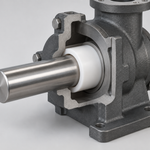
Typical PEEK CNC machining parts include insulators, seals, pump components, bushings, valves, rollers, semiconductor fixtures, and high-performance industrial components. For medical, food-contact, aerospace, or regulated applications, the exact PEEK grade and compliance requirement must be confirmed before quotation.
PEEK also creates cost risk when the blank size is oversized, the removal ratio is high, or the drawing requires unnecessary tight tolerances. Buyers should ask whether rough machining, stress relief, annealing, or final inspection steps are needed.
Engineering heuristic: Use PEEK when the failure cost justifies the material cost. Do not use it as a default upgrade for every plastic part.
Nylon CNC Machining: Best for Tough Wear Parts, Risky for Humidity-Sensitive Fits
Nylon / PA is tough, wear-resistant, and useful for parts that see impact, abrasion, or repeated mechanical contact. It is common in bushings, spacers, rollers, pads, guides, and rugged functional parts.
The main risk is moisture absorption. Moisture can change finished part dimensions and may also affect mechanical or electrical behavior.
This matters for precision fits. A Nylon part may pass inspection after machining but shift later when humidity, conditioning, or storage conditions change.
For tight-fit nylon CNC machining projects, the RFQ should define the grade, humidity exposure, conditioning state, inspection timing, and acceptable tolerance range. If the part has bearing fits, press fits, long flat surfaces, or tight hole spacing, review whether POM or a controlled Nylon grade would reduce risk.
Engineering heuristic: Nylon is good for rugged functional parts. It is not automatically safe for tight precision fits in changing humidity.
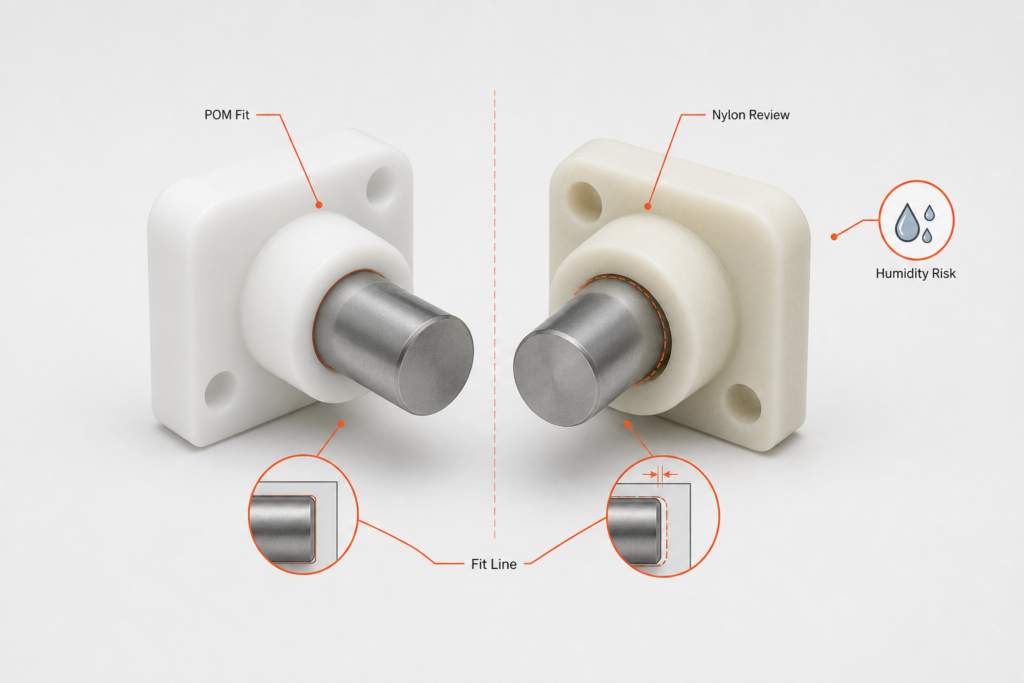
POM and Nylon fit review: use humidity and tolerance conditions to guide material choice.
Machining Polycarbonate: Best for Transparent Impact-Resistant Guards
PC / Polycarbonate is a strong candidate for transparent covers, guards, shields, machine windows, sight windows, and protective components. It is usually chosen when impact resistance matters more than perfect optical clarity.
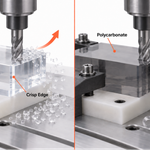
Machining polycarbonate requires careful control of heat, tools, clamping, and post-machining stress. Poor machining practice, sharp inside corners, tight fasteners, or solvent exposure can increase cracking, crazing, stress whitening, or surface haze risk.
If the transparent part is a guard or machine window, PC is often safer than PMMA. If the part is mainly a display panel, light guide, or cosmetic transparent component with low impact risk, PMMA may be a better fit.
Engineering heuristic: Choose PC for transparent impact-resistant guards. Choose PMMA when cosmetic clarity matters more than impact resistance.
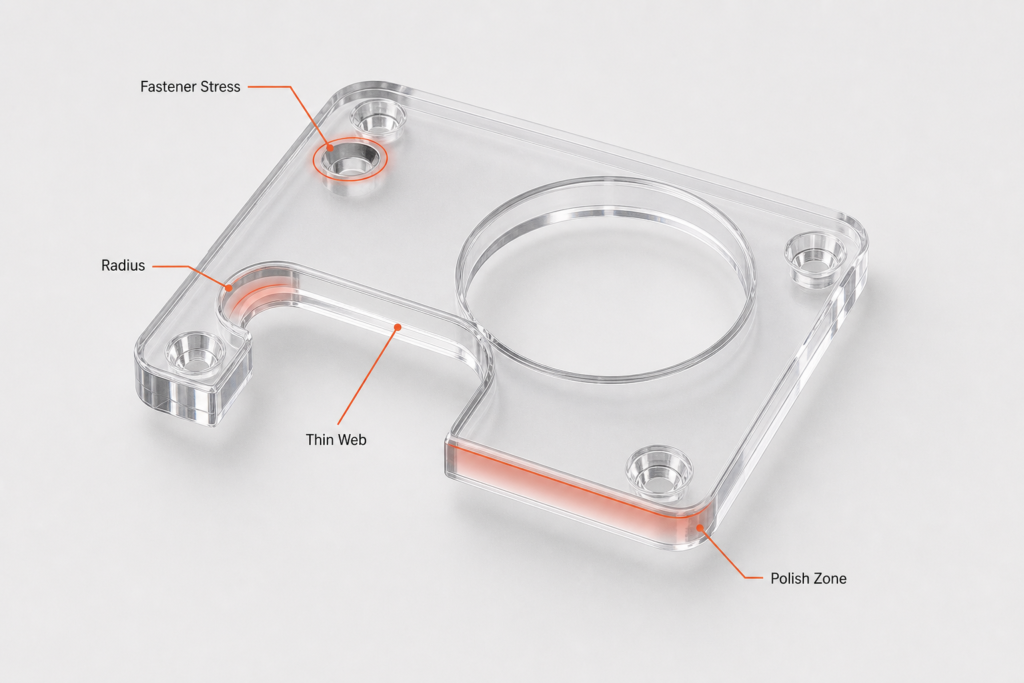
Transparent plastic part DFM review: fastener stress, radii, thin webs, and polishing zones.
ABS CNC Machining: Best for Low-Cost Prototypes, Housings, and Fixtures
ABS is a practical choice for low-cost prototypes, housings, covers, fixture bodies, models, and display parts. It is useful when buyers need quick validation without paying for high-performance engineering plastic.
ABS CNC machining should not be treated as a universal final-use solution. It may be a poor choice for high heat, harsh chemicals, outdoor exposure without the right grade, or parts carrying long-term load.
Before moving from prototype to low-volume production or end-use production, review whether ABS still fits the thermal, chemical, load, appearance, and life-cycle requirements. Many prototype parts can start in ABS, but production parts may need POM, PC, Nylon, PEEK, or another engineering plastic.
Engineering heuristic: Use ABS for cost-controlled validation, housings, covers, and fixtures. Recheck the material before moving from prototype to production.
Acrylic CNC Machining (PMMA): Best for Clear Cosmetic and Display Parts
PMMA, commonly called acrylic, is used when the part needs clarity, gloss, clean edges, or display-quality appearance. It is common in clear panels, light guides, signage, display fixtures, windows, and cosmetic transparent components.
Acrylic CNC machining is not the same as machining a tough guard material. PMMA can crack under tight fasteners, sharp corners, thin webs, or poor edge finishing.
For acrylic CNC machining projects, define the required visual level before quotation. A machined acrylic part may need edge polishing, mechanical polishing, flame polishing, or another specified finishing method depending on the cosmetic requirement.
Engineering heuristic: Choose PMMA for clarity and appearance. Choose PC if the part may be hit, dropped, clamped, or used as a protective shield.
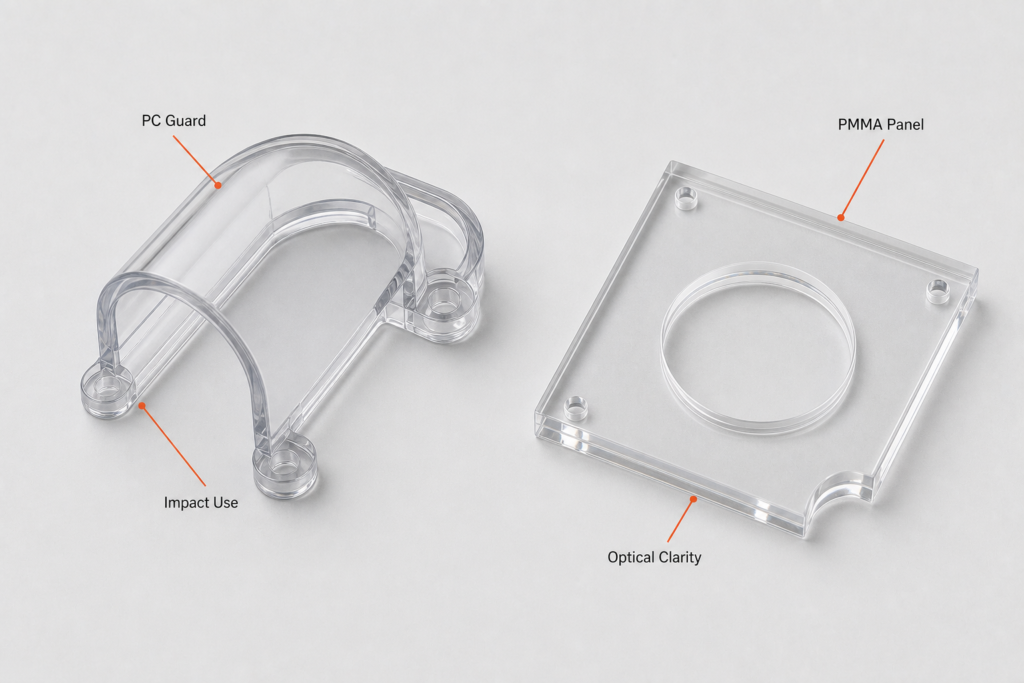
PC and PMMA selection: impact-resistant guarding versus optical clarity and cosmetic display use.
CNC Plastic Machining Tolerance Risks
The most common plastic CNC mistake is applying metal tolerance logic to polymer parts. A tolerance that looks normal on an aluminum bracket can be unrealistic on a Nylon spacer, large PMMA panel, thin PC cover, or stress-sensitive PEEK component.
| Risk Factor | Why It Matters | RFQ Control |
| Moisture absorption | Can change part dimensions, especially in Nylon | Define service humidity, grade, conditioning state, and inspection condition |
| Thermal expansion | Plastic expands more than metal under temperature change | Define service temperature and mating materials |
| Residual stress | Can cause warping, cracking, or post-machining movement | Review stock, roughing, rest time, annealing, and fixturing |
| Clamping deformation | Soft or thin plastic can distort under vise pressure | Use soft jaws, tabs, sacrificial zones, or low-stress fixturing |
| Surface finish requirement | Clear plastics may need secondary finishing | Define cosmetic, optical, or functional surface requirements |
| Overtight tolerances | Raises machining cost and rejection risk | Separate critical dimensions from non-critical dimensions |
For plastic parts, tolerance is not only a machine capability question. It is also a material and application question.
A strong supplier should help the buyer decide which dimensions must be controlled tightly and which dimensions can be opened without affecting function.
Why Quote-Only Material Selection Creates Risk
Fast quoting is not the problem. The real risk starts when material choice is treated only as a quote field instead of being reviewed against application conditions, assembly method, tolerance, and surface requirements.
A buyer may upload a file, select “Nylon,” “Acrylic,” or “clear plastic,” and receive a price and lead time quickly. That does not mean the material has been checked against the application.
Nylon problems may appear after humidity exposure. PMMA problems may appear after assembly. PC problems may appear after solvent cleaning. PEEK problems may appear when the buyer realizes the material was over-specified for the real duty cycle.
At PlasticHubs, we do more than confirm whether a material can be machined. We check whether the material, geometry, tolerance, finish, assembly method, and service conditions make sense before machining starts.
DFM Review Is Insurance Against Material Failure
DFM review is not only about wall thickness, hole depth, or corner radius. For machined plastic parts, it is also a material-risk review.
A strong DFM review checks whether the selected plastic can hold the drawing tolerance, survive the fixture strategy, meet the surface finish requirement, and work in the final environment. It also checks whether the quote is missing inspection details, grade requirements, finishing steps, or assembly conditions.
For NPI teams, this review works as insurance against late-stage rework. The cheapest quote is not cheap if the part cracks after assembly, shifts after moisture exposure, or requires a new material after the pilot run.
What to Send Before RFQ
| RFQ Input | Why It Matters |
| 3D CAD file | Defines geometry, stock removal, tool access, and machining path |
| 2D drawing | Defines critical tolerances, threads, surface finish, and inspection points |
| Material name + grade | Prevents vague requests such as “Nylon” or “Acrylic” without grade control |
| Quantity | Affects stock planning, fixture strategy, and cost per part |
| End-use environment | Controls heat, chemical, humidity, UV, load, and wear review |
| Mating parts | Helps assess fit, clearance, fastener stress, and thermal mismatch |
| Surface finish requirement | Separates machined finish from polished, cosmetic, or optical surfaces |
| Inspection requirement | Defines CMM, manual inspection, critical dimensions, and reporting needs |
| Production stage | Prototype, functional validation, pilot run, or low-volume production may need different material logic |
If the drawing only says “plastic,” “clear plastic,” or “Nylon,” the RFQ is incomplete. We review the part function, service conditions, and critical dimensions before locking the material and quote logic.
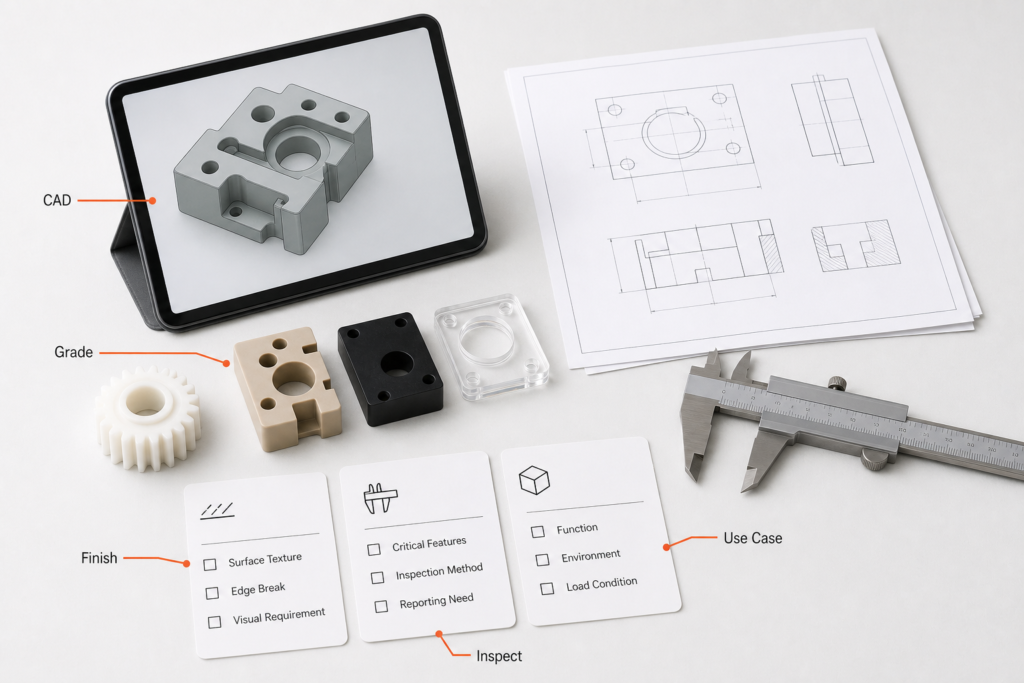
RFQ review inputs for plastic CNC machining: CAD, grade, finish, inspection, and use case.
How to Evaluate a Plastic CNC Machining Supplier
A supplier that only says “we can machine POM, PEEK, Nylon, PC, ABS, and PMMA” is not giving enough engineering value. The key question is whether the supplier can explain why one material is safer than another for your part.
| Supplier Question | Strong Answer Should Cover |
| Can this material hold the requested tolerance? | Plastic tolerance limits, critical dimensions, stock behavior, inspection method |
| Will Nylon absorb moisture in this application? | Grade, conditioning, humidity, fit risk, inspection timing |
| Should this clear part be PC or PMMA? | Impact need, optical finish, polishing, fastener stress |
| Is PEEK justified here? | Heat, chemical exposure, load, failure cost, blank waste |
| Can the part be machined without warping? | Fixturing, roughing, stress relief, wall thickness, stock form |
| Is the surface finish realistic? | Tool marks, polishing method, haze, clear-part finishing |
If material choice is treated only as a quote field, the buyer may not see the problem until machining, assembly, or field use. Plastic CNC projects need material logic to be reviewed before the first part is cut.
How We Support CNC Plastic Material Selection
At PlasticHubs, we support machined plastic parts in POM, PEEK, Nylon, PC, ABS, PMMA, and other engineering plastics.
Our support is not only a material list. We review material choice, DFM risk, tolerance requirements, surface finish needs, and inspection inputs before machining starts. This helps engineering and sourcing teams compare quotes based on manufacturability, not price alone.
If your part is moving from prototype to low-volume production, we can review the CAD file, drawing, material grade, quantity, finish, tolerance, and service conditions before production.
FAQ: Best Plastics for CNC Machining
What is the best plastic for CNC machining overall?
There is no single best plastic for every machined plastic part. POM is often a strong first material to review for precision functional parts because it offers low friction, wear resistance, machinability, and dimensional stability.
Is PEEK always better than POM or Nylon?
No. PEEK is better only when the application needs high heat resistance, chemical resistance, high mechanical performance, or long-term stability in demanding conditions.
If the part is a standard wear block, bushing, spacer, or fixture, POM or Nylon may be more cost-effective and easier to justify.
Is Nylon good for tight-tolerance CNC machined parts?
Nylon can be machined into functional parts, but it is risky for humidity-sensitive tight fits. Moisture absorption can change finished part dimensions, so grade selection, conditioning, and inspection conditions matter.
Should I choose PC or PMMA for a clear CNC machined part?
Choose PC when impact resistance and toughness matter. Choose PMMA when optical clarity, clean edges, display quality, or cosmetic appearance matter more than impact resistance.
Is ABS good for final-use machined plastic parts?
ABS can be suitable for housings, covers, guards, fixtures, prototypes, and display parts. It should be reviewed carefully when the part faces heat, chemicals, outdoor exposure, or long-term load.
Why do CNC machined plastic parts warp after machining?
Warping can come from residual stress in the stock material, machining heat, tool pressure, clamping force, uneven wall sections, or moisture and temperature changes after machining. Rough machining, rest time, annealing, sharp tools, controlled feeds, and careful fixturing can reduce this risk.
What files should I send for a plastic CNC machining quote?
Send the 3D CAD file, 2D drawing, material grade, quantity, finish requirement, critical dimensions, inspection needs, and end-use conditions. Include humidity, temperature, chemical exposure, mating parts, and assembly method if they affect performance.
Send Your CAD File for Plastic Material and DFM Review
Choosing the right CNC plastic is a manufacturing decision, not a material-table lookup. Before you lock the drawing, review whether the selected plastic can hold the required tolerance, survive the application environment, meet the surface finish, and assemble without cracking or distortion.
Send your CAD file, drawing, material grade, quantity, tolerance requirements, surface finish needs, and end-use conditions. We can review the material choice and DFM risks before machining to help reduce rework, scrap, and late-stage material changes.