We provide CNC Polycarbonate machining services designed to support engineers and businesses that require strong, transparent, and impact-resistant components. Our team ensures reliable quality for prototypes and production runs.
Get instant access to our online CNC services for your polycarbonate parts, supported by capable machining that handles complex features with ease. Just upload your files to receive a quick quote, and we’ll take care of the rest. We focus on delivering clear, durable PC components made to your specifications, all backed by a fast turnaround.
We offer versatile CNC machining options for polycarbonate parts to meet both structural and optical-grade requirements.
Upload your 3D models (STL, STEP, etc) or 2D drawing files for instant quotes. We will respond within 24 hours. All data is secure and confidential.
Polycarbonate offers stable machining performance that supports tight tolerances, smooth finishes, and consistent clarity across complex geometries. At PlasticHubs, we deliver these capabilities through controlled CNC processes that ensure accuracy and repeatability for every PC component.
| Standards | Detail |
|---|---|
| Tolerances | +/- 0.01 mm |
| Minimum Wall Thickness | 0.5 mm |
| Minimum End Mill Size | 0.5 mm |
| Maximum Part Size | 4000 mm×1500 mm×600 mm |
| Minimum Part Size | 1 mm×1 mm |
| Price | $ $ $ $ |
| Standard Lead Time | 1-7 business days based on machined parts |
| Process Compatibility | Full CNC capabilities including milling, turning, drilling |
Polycarbonate is known for its exceptional balance of strength, clarity, and heat resistance, offering an impact strength often exceeding 600–850 J/m, light transmission around 86–90%, and a heat deflection temperature near 125–135 °C. These characteristics make it a highly reliable engineering plastic for CNC machining, as it maintains dimensional stability, resists cracking under load, and delivers optical-grade surfaces when processed correctly. Its combination of toughness and transparency enables high-performance components across mechanical, optical, and protective applications.
| Mechanical Properties | Value |
|---|---|
| Density | 0.0434 lb/in³; 1.20 g/cm³ |
| Tensile Strength, Yield | 39.0 - 120 MPa |
| Tensile Elongation at Break | 88.6 % |
| Flexural Strength | 88.6 MPa |
| Tensile Strength, Ultimate | 28.0 - 75.0 MPa |
| Hardness, Rockwell R | 114 - 124 |
| IZOD Notched Impact | 0.900 - 18.0 ft-lb/in |
| Other Properties | Value |
|---|---|
| Thermal Conductivity | 0.173 - 0.210 W/m-K |
| Heat Deflection Temp at 264 psi | 80.0 - 170 °C |
| Melting Point | 220 - 315 °C |
| Max Operating Temp. | 115 - 135 °C |
| CTE, linear | 0.650 - 70.2 µm/m-°C |
| Mold Temperature | 60.0 - 120 °C |
| Flammability, UL94 | HB - 5VA |
Our experience with pc allows us to optimize CNC processes while preserving strength, and durability that meet your needs.
We support tailored designs, from unique geometries to specialized features, meeting both functional and special requirements.
We ensure smooth, clear, and polished pc surfaces that highlight the material’s quality. We can create any finish you need.
As an ISO 9001:2015 certified company, we provide SGS, RoHS, material certifications, and inspection reports to ensure the highest quality.
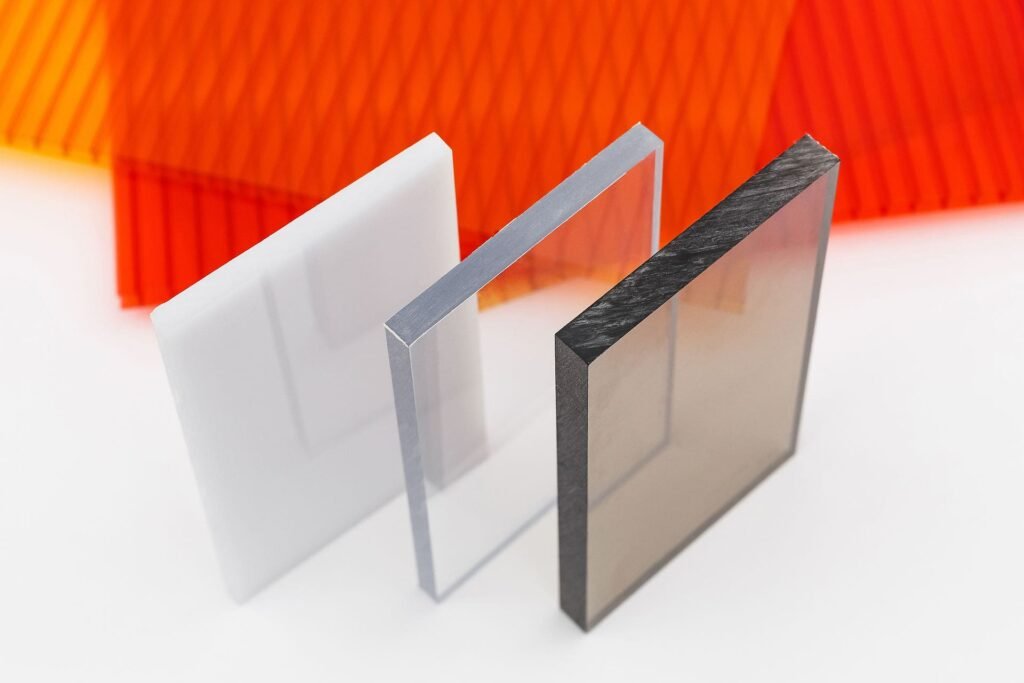
Polycarbonate is a durable, transparent engineering thermoplastic valued for its outstanding impact resistance, thermal stability, and optical clarity. It is commonly produced as standard PC, UV-stabilized PC for outdoor use, and glass-filled PC for applications requiring higher rigidity. Its balanced mechanical and optical properties allow it to perform reliably in demanding environments, making it a preferred choice for protective covers, optical components, enclosures, and structural parts across technical industries.
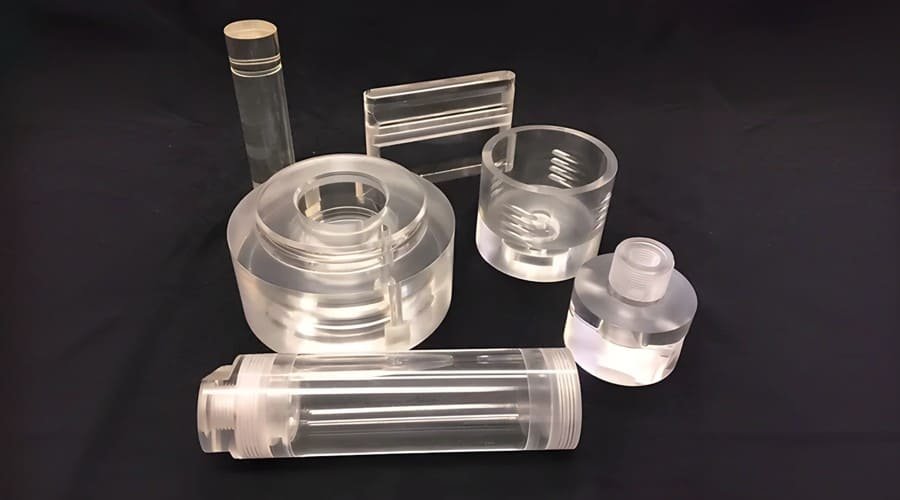
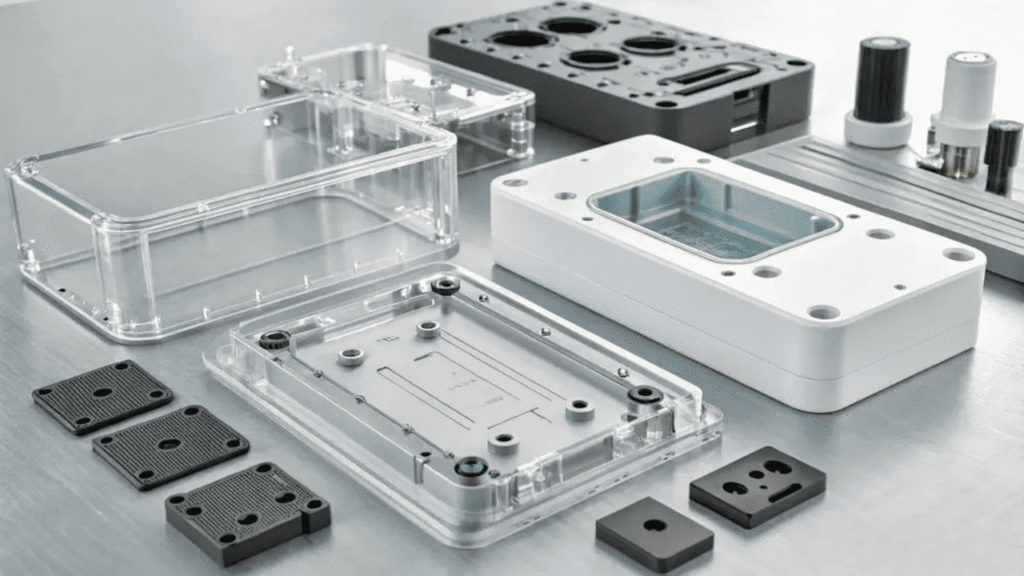
Yes, polycarbonate can be precisely CNC cut using milling, turning, or drilling, producing clean edges and detailed features without cracking.
Absolutely. Polycarbonate is highly machinable, maintaining dimensional stability and surface clarity when proper CNC techniques and cutting parameters are used.
Polycarbonate is generally easier to machine without cracking, thanks to its superior impact resistance, while acrylic requires more careful handling to avoid chipping or shattering.
No, polycarbonate is highly resistant to cracking and impact, making it one of the toughest transparent plastics available for CNC machining.
The most effective method for cutting polycarbonate is using CNC milling, turning, or routing with sharp, high-speed tools while controlling feed rates to around 0.05–0.15 mm/rev (depending on thickness) and using light lubrication or air cooling. This minimizes heat buildup, prevents surface melting or stress whitening, and maintains the material’s clarity and dimensional accuracy. For drilling, using a high-speed steel or carbide drill with a point angle of 90–118° helps avoid cracking and ensures clean holes.
Plexiglass is a trade name for acrylic (PMMA) and differs significantly from polycarbonate (PC). Acrylic has a tensile strength of about 70 MPa and impact strength of 10–20 J/m, making it rigid but brittle, whereas polycarbonate offers a tensile strength of 55–75 MPa but an impact strength of 600–850 J/m, giving it far superior toughness. Polycarbonate also withstands higher heat (heat deflection temperature ~125–135 °C vs. 100 °C for acrylic) and is more suitable for applications requiring durability, impact resistance, and optical clarity under stress.