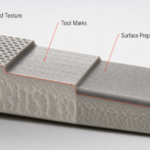
Plastic CNC machining involves cutting a solid block of plastic to remove excess material until the desired final shape is achieved. A computer controls the cutting tools and instructs the device on where to move and how fast to spin. Thanks to this control, the procedure can create components closely matching the digital model.
Plastics behave differently from metals. They bend more, weigh less, and heat up faster. When a machinist ignores these facts, the plastic can melt or warp. CNC machining of plastic offers durable, precise, and clean custom components when the machinist selects sharp tools, intelligent cutting speeds, and adequate cooling.
Since no mould is needed, this method is excellent for prototypes, unique single parts, and low-volume runs. CNC machining plastic often makes sense when injection moulding would be too expensive or take too long to set up.
What Is It & How Does It Work?
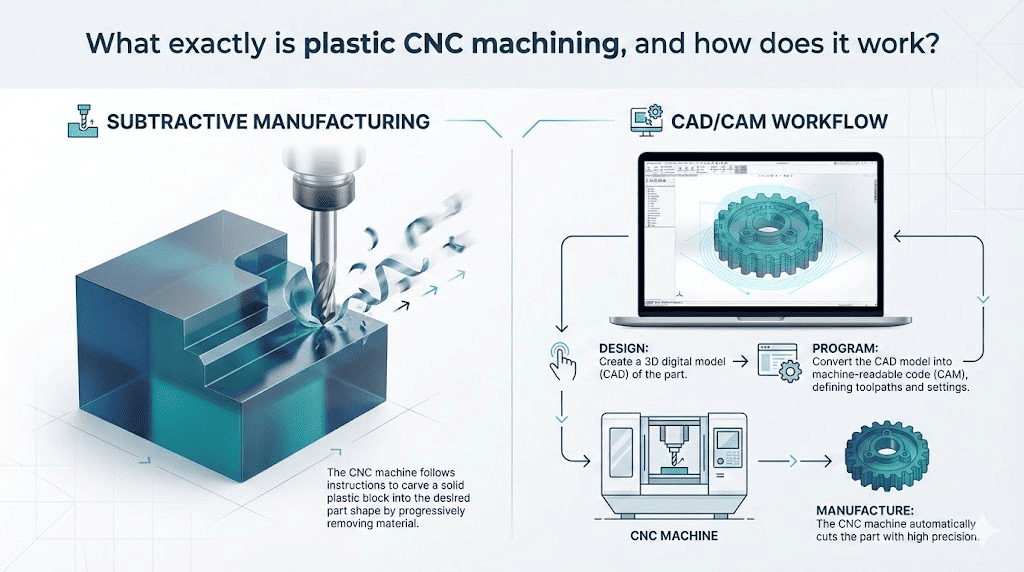
Plastic CNC machining is a computer-controlled technique that cuts a solid block of plastic into a part. The machine uses a program that instructs it to remove material step by step until the part is complete according to the digital model.
Core principle of subtractive manufacturing
In subtractive manufacturing, you start with surplus material. You eliminate other material until only the desired shape is left. People call it “subtractive” because you are removing material instead of adding more to it, layer by layer, similar to 3D printing. With this technique, the part remains solid and often gets firmer and smoother than many printed parts.
The CAD/CAM workflow
A designer first creates their 3D model in CAD software. After that, a programmer will load this model into CAM software and set the tools, speeds and paths. The CAM program then creates code for the machine.
Eventually, the CNC machine interprets this code and directs the table and cutting tools in various directions. Most flat and basic 3D designs are made with 3-axis mills. For machining complex plastic parts, 5-axis mills are used, which tilt and auto-rotate the part to access multiple angles in a single setup.
Can You CNC Machine Plastics?
Machinists can successfully machine plastics on CNC machines with the right tooling, setup, and process. Many high-end parts utilise CNC-milled plastics to produce accurate, long-lasting components.
Machining plastic vs. machining metal
Plastics bend and heat up in ways that metals do not. Often, metal chips break off in short pieces and take heat with them. Plastic chips can become long and stringy, potentially causing heat to get trapped. Unlike metals, plastics have a spring-back under clamping force. They become flexible.
Because of this, a good plastic machining service.
- The plastic is clamped with just the right force.
- These tools must choose sharp knives that cut rather than rub the pulp.
- It sets cutting speeds as well as feeds to lower the heat.
When machinists acknowledge these distinctions, they can create plastic parts that are reliable and repeatable.
Thermal management and tool selection
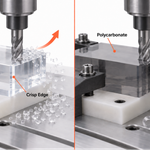
Heat causes most problems in the CNC machining of plastic. When a part is subjected to excessive heat, its surface starts to melt, its edges smear, and chips of glue reattach to the part. To avoid this, they use tools specially designed for plastics with smooth, sharp edges. Experts generally run the spindle at a fast speed, but they set the feed and depth so that the tool cuts cleanly and leaves before building up heat.
A light mist or air is blown over the cut to cool the plastic and clear the chips. Well-designed toolpaths prevent the tool from remaining in one spot for too long, thereby preventing overheating. This method ensures the coolness, cleanliness, and accuracy of our output parts.
Plastic Materials For CNC Machining Projects?
To choose the best plastic for CNC machining, it is crucial to match the plastic to the part’s intended function. After balancing out all of the material properties, you then check how well the material machines. The current common plastics for cnc machining are as follows:
- Acrylic (PMMA)
- POM
- Polycarbonate
- PEEK
- Nylon
- ABS
Engineering thermoplastics for high-performance parts
For highly stressful and hot manufacturing applications, engineers specify engineering thermoplastics. For example:
- Designers use PEEK in medical implants, aircraft brackets, and severe industrial settings since it can handle extremely high temperatures and strong chemicals.
- Acetal (often referred to as Delrin) feels hard and slippery. It cuts easily and is useful for gears, pulleys, and precision moving parts that require low friction.
- Due to nylon’s toughness and good wear resistance, it often appears in bushings, spacers, and structural parts that experience impact and motion.
While they are more costly than manufacturing generic materials, these engineering plastics enable CNC machining services to produce long-lasting, high-performance custom plastic parts.
Common plastics for prototyping
Many simple plastic prototypes and everyday things work fine.
ABS machines easily. It takes paint and texture and gives good strength. The item is present in a variety of housing, cover, and consumer goods. Engineers specify polycarbonate for light covers, safety shields, and lens housings because it resists impact and remains clear.
Acrylic (PMMA) shines when you need a glass‑like look. Machinists can smooth it out until it appears clear and shiny.
Numerous groups utilise them for CNC plastic prototyping and initial designs due to their affordability, aesthetics, and strength.
5 key material selection questions
Before choosing a material, ask yourself a few questions.
- How much load or impact will the part see?
- How hot will it get during normal use or cleaning?
- Will the surface come in contact with oils or fuels?
- What appearance do you want for your wall: clear, matte, glossy, painted, etc?
- What budget and quantity do you envisage for this design?
Together with your machining partner, you can narrow down to the best plastic for working on your CNC job when you answer these questions.
Advantages Of CNC Machining Plastic Parts
Plastic CNC machining offers numerous significant advantages for projects that require high precision and flexibility.
Tight tolerances and superior surface finishes
Since the equipment works with coded instructions, it can maintain dimensions within tight tolerances. This is particularly important when you need to help with parts that should fit together with minimal clearance or to create smooth motion between mating parts. A stable setup and sharp tool will also enable the machine to leave clean surfaces, requiring only light deburring or polishing.
3D-printed parts often show their layers, but when we machine in a CNC process, the plastic finishes finer. As such, it has a more robust and uniform material inside.
Speed and cost‑effectiveness
CNC machining of plastic eliminates the need for costly molds for prototypes and low-volume runs. You only need a good CAD model and a clear drawing. The program is updated by the machinist as opposed to rebuilding a tool when the design is changed.
You also get pieces made with real engineering plastics, not just with the printing resins. You can test strength, fit, and durability in conditions close to final use. For early functional testing, many teams opt for CNC machining plastic instead of other processes.
Get Started With A Custom Plastic CNC Machining Project?
Services like PlasticHubs’ CNC machining offer online quotes and expert DFM reviews. Your component is examined by our teams, and suggestions of better materials or design tweaks (if necessary) are made to avoid surprises.Applications of CNC Machined Plastic Parts
CNC plastic components are part of almost every contemporary sector. When designers need custom plastic parts that are mint, lightweight, and precise, they pick this process more often than not.
Aerospace
In aerospace, designers rely on machined plastic ducts for air systems, lightweight wire chase covers and interior trim. When it comes to a plane or spacecraft, every gram of weight counts, so plastics replace metal where a design permits.
Medical devices
In medical devices, engineers use plastic CNC machining to produce PEEK brackets for MRI machines, handles for surgical processes and casings for pumps and diagnostic gears. The components must comply with stringent criteria for purity, safety and sometimes biocompatibility. CNC machining aids teams in delivering quality results every time.
Electronics
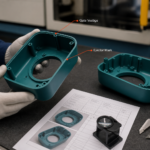
Electronics makers commonly use CNC machining plastic for parts like PCB holders, switch panels, sensor housings, and camera enclosures. For instance, a team can get a clear polycarbonate lens housing for a prototype camera to test the optics and sealing.
Automotive
Automotive engineers commonly use machining to prototype plastic parts, such as dashboards, clips, and brackets. They put these components in test vehicles to check how they fit and feel. After that, they need to modify the design before proceeding to injection moulding.
Step‑by‑Step Plastic CNC Machining Process
The plastic machining process is straightforward: a raw block is machined into a finished part, with inspections.
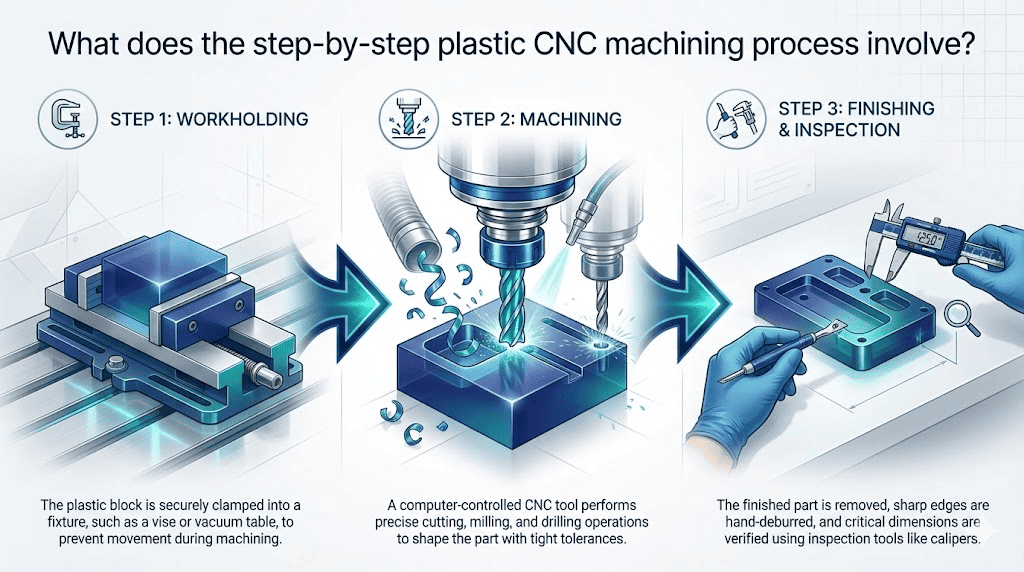
Step 1: Secure the plastic blank using a workholding device
To begin with, the machinist cuts the raw plastic stock to the rough size and mounts it on the machine. They may use a vice, clamps, or a vacuum table. The objective is straightforward: grip the part tightly enough to hold it in place so it does not move, but not so tightly that the part bends or deforms. The right workholding ensures accuracy in all subsequent processes.
Step 2: Selecting Strategic Toolpaths and Machining Operations
After that, the toolpaths generated by the CAM program are executed on the CNC machine. A machine might first flatten the top and then cut pockets, slots, and holes to shape the outer profile and any 3D curves.
The machinist carefully selects the order of these cuts. Thickness at the start provides support to delicate or thin features until the final stages of sculpting are reached. At the same time, they choose tools and cutting paths that protect the tool and are effective in chip removal.
Step 3: In‑process and post‑process finishing
After machining an object, the machinist usually measures key features of the machined object and checks for any heat or warpage. After performing the major cuts, they will remove the burrs, smooth out sharp edges if necessary, and then clean up the part. Some projects stop at this point. Some proceed to polishing, bead blasting, painting, or other finishing processes that lend their product a certain look and performance.
Challenges In CNC Machining Plastics
Plastic CNC machining presents unique challenges, but experienced machinists employ verified techniques to overcome them.
Preventing melting and achieving a clean cut
To prevent melting, machinists use sharp tools and smart cutting data. The slicers are sharp and polished to slice cleanly and reduce friction. The machinist selects the spindle speed, feed rate, and depth of cut to remove material at a sufficiently rapid rate, ensuring the tool does not sit in one place and overheat.
They commonly use air jets or a light mist of coolant to keep the cutting zone cool; the chips are then blown away. In the end, they might select a lighter finishing size to take a thin layer that leaves a smooth, accurate surface ready for use or for final polishing.
Managing static and chip evacuation for clarity
Plastic chips are known to build static charge and cling to the parts. Clear plastics are particularly prone to this effect, such as acrylic and polycarbonate.
To control this, shops aim air and vacuum systems towards the cutting zone to quickly evacuate chips. Some jobs may utilise antistatic sprays or grounded fixtures.
This method is preferable because it makes the part cleaner, prevents the clear parts from getting scratched, and makes it easier to see the cut.
Plastic CNC Machining vs 3d Printing vs Injection Moulding
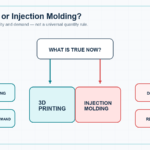
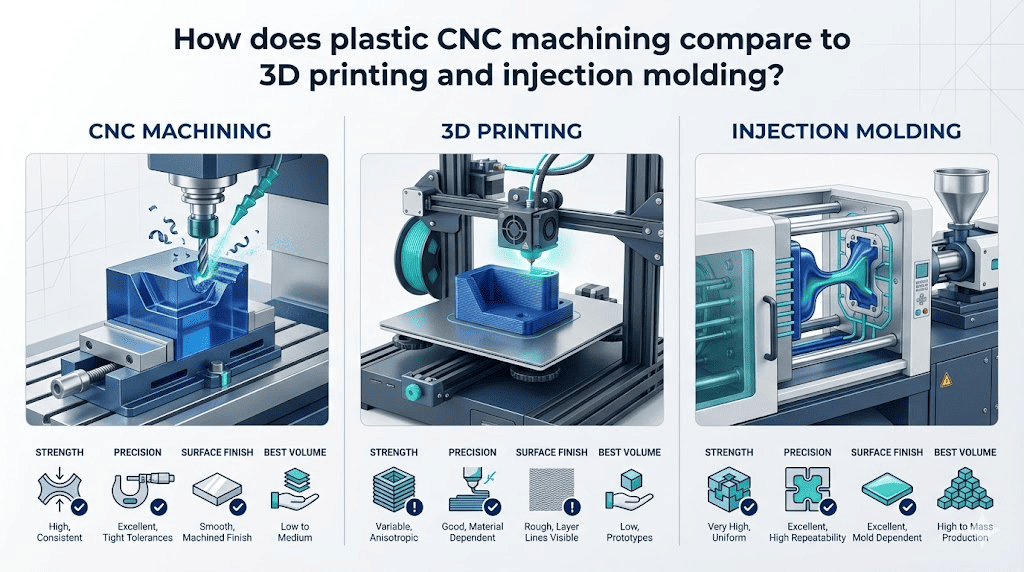
Plastic CNC machining, 3D printing, and injection moulding are best suited for different situations. When you understand how they are similar and which ones differ, you can choose the method that best suits your project.
CNC Machining vs. 3D Printing
CNC machines accommodate tighter tolerances and usually leave smoother surfaces, particularly on flat and less deeply curved surfaces.
Although machining can achieve a great variety of designs, some shapes are more challenging to create than others. It is also very quick and has little setup, so it is good for quick visual models.
Many teams opt for CNC plastic prototyping to create ‘works-like’ prototypes that must withstand real loads in real materials. 3D printing often makes more sense for very complex “looks‑like” models or quick shape checks.
CNC Machining vs. Injection Molding
The process of creating the mold will cost time and money, but once a factory has a mold, the factory can produce the product cheaply and fast. This suits large production runs.
Plastic CNC machining skips the mold. Its only requirements are the CAD model and CNC program. That way, you can start producing much earlier and change the design without tool rework. CNC machining usually provides a lower total cost and shorter lead time, from smaller and medium-sized batches to custom parts to early test runs.
Conclusion
Using plastic CNC machining, you can generate high-precision flexible parts from a range of engineering plastics that match your digital design. Machining works with solid stock and so can provide tight tolerances, fine finishes and strong, reliable parts.
When we choose/design a project, we select the material, shape and process carefully. You consider CNC Machining, 3D printing, and injection molding and select the best option based on your money, timetable, and performance requirements. You also hold Design for Manufacturability reviews to maintain low costs and high quality.
As a result of these strengths, engineers and designers across many fields now rely on plastic CNC machining for prototype and end-use parts. To dive deeper into specific plastics or to see how these ideas apply to your next design, you can visit the learning resources at PlasticHubs.
Frequently Asked Questions About CNC Plastic Machining
What tolerances can CNC-machined plastic parts hold?
Achievable tolerances depend on the resin and grade, part size, wall thickness, geometry, moisture condition, measurement temperature, and inspection method. Plastics can move as heat and internal stress change, so the drawing should separate function-critical dimensions from general dimensions. Confirm critical tolerances with the manufacturer after the material, geometry, and measurement conditions have been reviewed.
How can heat, warping, or cracking be reduced during plastic machining?
Use sharp, suitable cutting tools, clear chips efficiently, control heat input, support the workpiece without over-clamping, and avoid removing a large amount of material from only one side when the geometry is sensitive. Stock condition, residual stress, thin walls, deep pockets, drilled holes, and later assembly loads also matter. When the application warrants it, use staged machining or material-specific stress-relief practices and inspect after the final relevant operation.
Is CNC plastic machining suitable for prototypes and low-volume production?
Yes, when the part can be cut from available plastic stock and the design benefits from production-grade material, controlled dimensions, or a machined surface. It avoids mold tooling, which can make design changes and small batches easier to manage. The best process still depends on part geometry, quantity, material, finish, and unit-cost target; injection molding or additive manufacturing may be more suitable in other cases.
Can CNC-machined plastic parts include threads or inserts?
They can, but the joint should be designed for the selected plastic and expected assembly load. Thread form, engagement length, wall thickness, tightening method, repeated service, temperature, and creep behavior can affect reliability. For frequently assembled joints or higher loads, a suitable insert may be preferable to a directly machined plastic thread. Specify the fastener, torque or load condition, and assembly cycle in the drawing or RFQ.
What information should be included in a CNC plastic machining RFQ?
Provide a 3D model and dimensioned drawing, the exact plastic resin and grade, quantity, critical tolerances, surface and edge requirements, threads or inserts, inspection needs, and any color or appearance criteria. Also identify relevant service conditions such as temperature, chemical contact, UV exposure, moisture, impact, or repeated assembly. These details let the manufacturer evaluate material suitability, machining risk, inspection, and cost before production.